11P/Tempel–Swift–LINEAR
 Infrared image of Comet T–S–L taken by NEOWISE on 4 January 2021. | |
| Discovery[1] | |
|---|---|
| Discovered by | |
| Discovery date |
|
| Designations | |
| |
| |
| Orbital characteristics[4][2] | |
| Epoch | 21 November 2025 (JD 2461000.5) |
| Observation arc | 154.75 years |
| Number of observations | 1,337 |
| Aphelion | 5.18 AU |
| Perihelion | 1.387 AU |
| Semi-major axis | 3.283 AU |
| Eccentricity | 0.57739 |
| Orbital period | 5.95 years |
| Inclination | 14.432° |
| 238.86° | |
| Argument of periapsis | 168.06° |
| Mean anomaly | 301.36° |
| Last perihelion | 26 November 2020[2] |
| Next perihelion | 9 November 2026[3] |
| TJupiter | 2.839 |
| Earth MOID | 0.403 AU (60.3 million km) |
| Jupiter MOID | 0.326 AU (48.8 million km) |
| Physical characteristics[4] | |
Mean radius | 0.6 km (0.37 mi)[5] |
| Comet total magnitude (M1) | 15.2±0.7 |
| Comet nuclear magnitude (M2) | 18.6 |
11P/Tempel–Swift–LINEAR is a periodic comet roughly 1 km in diameter with a 5.95-year orbit around the Sun. At the perihelion passage on 9 November 2026 the solar elongation will be 170 degrees.[6] The closest approach to Earth will be two days later on 11 November 2026 at a distance of 0.401 AU (60.0 million km).[4][6][a] The comet may brighten enough in late 2026 to get into the reach of smart telescopes.
Observational history
Discovery
In 1869, the comet's perihelion was around 1.063 AU (159.0 million km) from the Sun.[7] Ernst Wilhelm Leberecht Tempel originally discovered the comet on 27 November 1869, from his observatory at Marseille. It was later observed by Lewis Swift from the Warner Observatory on 11 October 1880, and he realised that it is the same comet as Tempel's.[8]
Loss and recovery
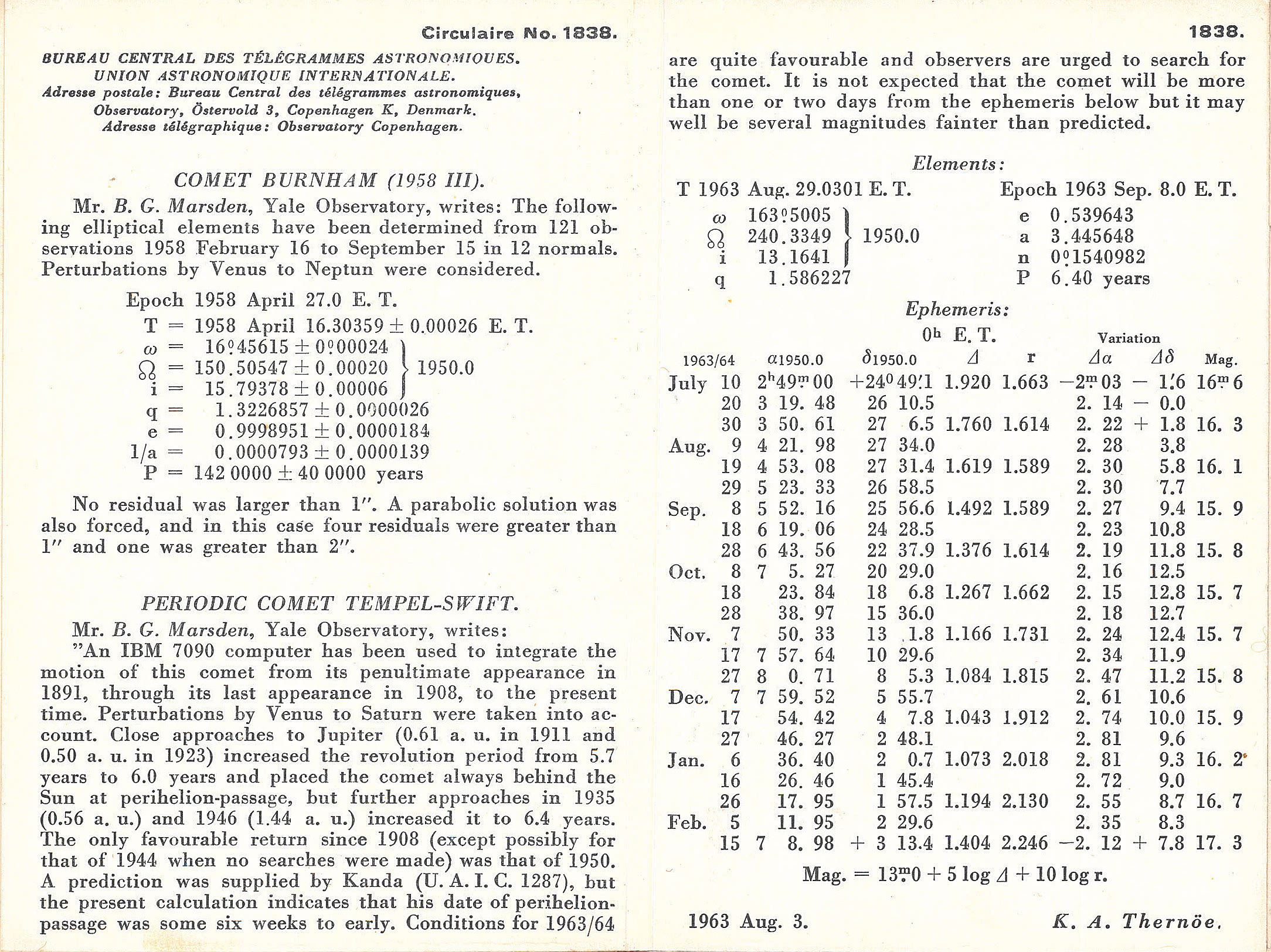
After 1908, the comet became an unobservable lost comet due to a series of four close flybys of Jupiter between 1911 and 1946[b] perturbing its orbit significantly enough that made subsequent apparitions of the comet unfavorable for observations in decades.[9] Nevertheless, Brian G. Marsden computed the resulting orbit based on the observations between 1891 and 1908, and predicted a favorable return in 1963, however the comet remained unobserved.[9] Despite this, additional predictions of the comet's favorable returns were later attempted by Marsden and Zdenek Sekanina in 1971,[10] and Shuichi Nakano in 1995.
On 7 December 2001, an object designated as P/2001 X3 was found by the Lincoln Near-Earth Asteroid Research (LINEAR) program.[11] Analysis of images taken between 10 September and 17 October 2001 later confirmed that P/2001 X3 was the recovery of the previously lost comet Tempel–Swift.[1]
Recent observations
The comet was not observed during the 2008 unfavorable apparition because the perihelion passage occurred when the comet was on the far side of the Sun.[12][2] The comet was observed during the 2014 and 2020 apparitions.[2] The comet will next come to perihelion on 9 November 2026,[3] then two days later on the 11th, make a closest approach to Earth of 0.4012 AU (60.02 million km).[4]
2104
| Date & time of closest approach |
Earth distance (AU) |
Sun distance (AU) |
Velocity wrt Earth (km/s) |
Velocity wrt Sun (km/s) |
Uncertainty region (3-sigma) |
Reference |
|---|---|---|---|---|---|---|
| 2104-Nov-14 17:17 | 0.318 AU (47.6 million km; 29.6 million mi) | 1.28 AU (191 million km; 119 million mi) | 9.5 | 33.2 | ± 1137 km | Horizons |
Notes
- ^ The 2026 Earth approach of 0.401 AU (60.0 million km) is closer than the (Epoch 2019) Earth–Minimum orbit intersection distance (MOID) of 0.403 AU (60.3 million km).
- ^ 11P/Tempel–Swift–LINEAR approached Jupiter at a distance of 0.61 AU (May 1911), 0.50 AU (July 1923), 0.56 AU (April 1935), and 1.33 AU (November 1946) respectively.[9][10]
References
- ^ a b C. Hergenrother; K. Muraoka; S. Nakano (20 December 2001). D. W. Green (ed.). "Comet 11D (Tempel–Swift) = P/2001 X3 (LINEAR)". IAU Circular. 7779 (1). Bibcode:2001IAUC.7779....1H.
- ^ a b c d "11P/Tempel–Swift–LINEAR Orbit". Minor Planet Center. Retrieved 28 October 2014.
- ^ a b "Horizons Batch for 11P/Tempel-Swift-LINEAR (90000220) on 2026-Nov-09" (Perihelion occurs when rdot flips from negative to positive). JPL Horizons. Archived from the original on 11 February 2023. Retrieved 25 September 2025. (JPL#K204/13 Soln.date: 2023-Oct-10)
- ^ a b c d "11P/Tempel–Swift–LINEAR – JPL Small-Body Database". ssd.jpl.nasa.gov. Jet Propulsion Laboratory. Archived from the original on 24 April 2026. Retrieved 12 July 2023.
- ^ M. J. S. Belton (2014). "The Size-distribution of Scattered Disk TNOs from that of JFCs between 0.2 and 15-km effective radius". Icarus. 231 (1): 168–182. arXiv:1312.1424. Bibcode:2014Icar..231..168B. doi:10.1016/j.icarus.2013.12.001.
- ^ a b G. van Buitenen. "11P/Tempel-Swift-LINEAR". astro.vanbuitenen.nl. Retrieved 21 April 2026.
- ^ Kinoshita, Kazuo (2 December 2014). "11P/Tempel-Swift-LINEAR past, present and future orbital elements". Comet Orbit. Archived from the original on 20 May 2011. Retrieved 27 July 2023.
- ^ G. W. Kronk. "11P/Tempel–Swift–LINEAR". Cometography.com. Retrieved 28 October 2014.
- ^ a b c B. G. Marsden (3 August 1963). K. A. Thernöe (ed.). "Periodic Comet Tempel–Swift". IAU Circular. 1838 (2).
- ^ a b B. G. Marsden; Z. Sekanina (1971). "Comets and Nongravitational Forces. IV". The Astronomical Journal. 76 (10): 1135–1152. Bibcode:1971AJ.....76.1135M. doi:10.1086/111232.
- ^ R. Huber; G. Hug (19 December 2001). D. W. Green (ed.). "Comet P/2001 X3 (LINEAR)". IAU Circular. 7779 (2). Bibcode:2001IAUC.7778....2H.
- ^ Seiichi Yoshida (7 April 2009). "Tempel–Swift–LINEAR". Seiichi Yoshida's Comet Catalog. Retrieved 19 February 2012.
External links
- 11P/Tempel–Swift–LINEAR at the JPL Small-Body Database
- 11P/Tempel–Swift–LINEAR at Gary W. Kronk's Cometography
- 11P/Tempel-Swift-LINEAR at Seiichi Yoshida's website
- 11P/Tempel-Swift-LINEAR at Gideon van Buitenen's website
| |||||||||||||||
| |||||||||||||||
| |||||||||||||||

.png)