Ahmose, son of Ebana
Ahmose, son of Ebana | |
|---|---|
 Ahmose depicted in his tomb at El Kab | |
| Born | 16th century BC Nekheb (modern El Kab) |
| Died | 16th century BC Nekheb (modern El Kab) |
| Buried | El Kab |
| Allegiance | 17th Dynasty of Egypt 18th Dynasty of Egypt |
| Known for | Military service under Ahmose I, Amenhotep I, and Thutmose I |
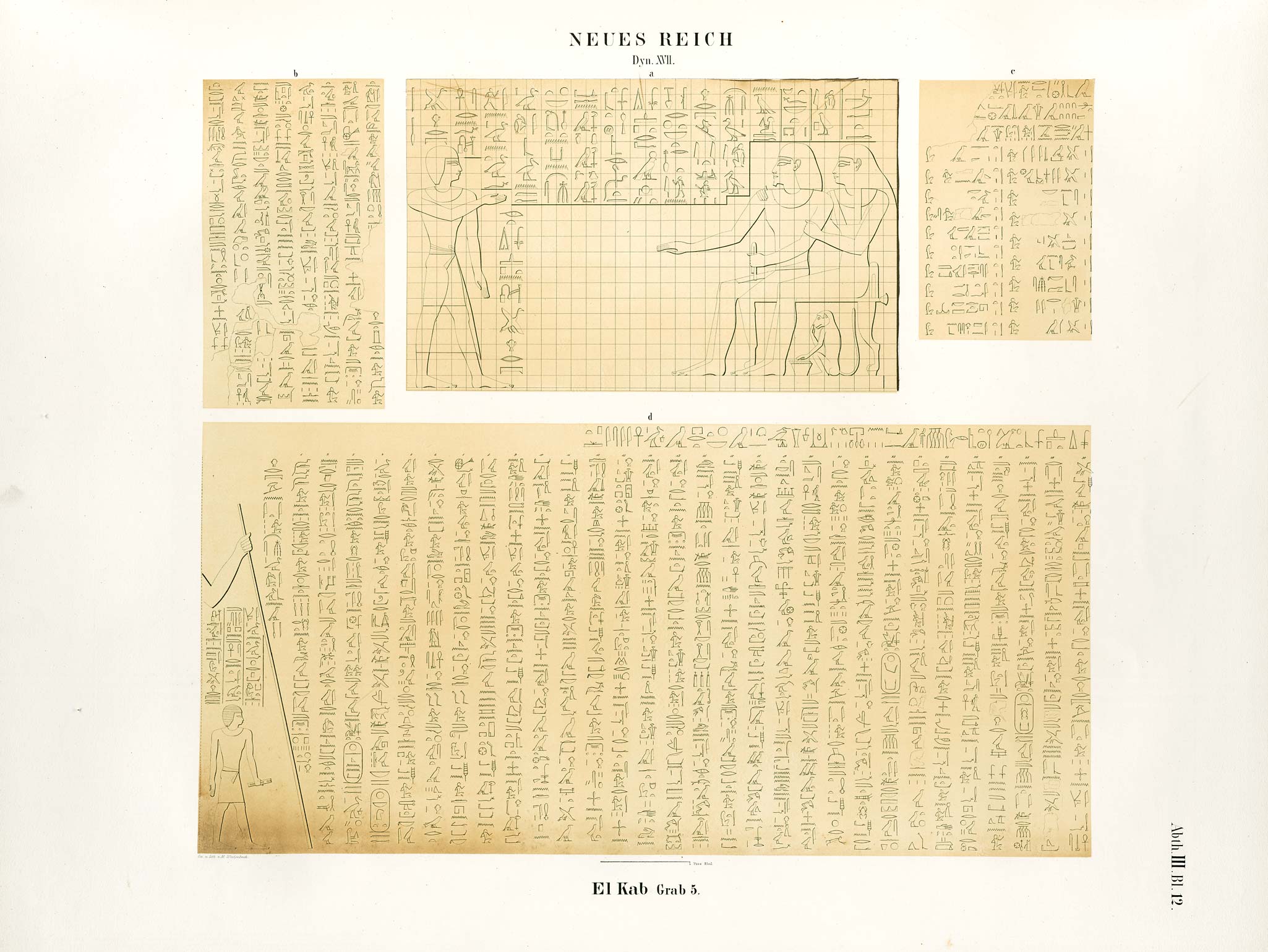
Ahmose, son of Ebana, (Amosis, Aahmes; meaning "Iah (the Moon) is born"[1]) served in the Egyptian military under the pharaohs Ahmose I, Amenhotep I, and Thutmose I.[2][3] His autobiography, which is inscribed on the wall of his tomb, and remains remarkably intact, is a valuable source of information on the late 17th Dynasty and the early 18th Dynasty of Egypt.[4][5]
Family
Ahmose was born in the city of Nekheb, the modern El Kab.[3]
Ebana was the name of Ahmose's mother, who was most likely a woman of importance on Egyptian society;[6][3] his father's name was Baba. Paheri, the grandson of Ahmose and a scribe and priest of the goddess Nekhbet and tutor to the prince Wadjmose, supervised the building of his grandfather's tomb.[7]
Life
Reign of Seqenenre
During the war to expel the Hyksos from Egypt, in the reign of Seqenenre Tao, his father enlisted in the navy.
Reign of Ahmose I
After the deaths of Tao and his son Kamose, Ahmose began to serve as a soldier under Pharaoh Ahmose I.[7] He participated in the battle of Avaris (the Hyksos capital in the Delta), where he killed two Hyksos and was awarded the "gold of valor" twice.[8] Ahmose was awarded slaves and other spoils by the pharaoh after Avaris was sacked. Ahmose also participated in the three-year siege of Sharuhen in southern Canaan for which he was rewarded. He followed his king to Nubia, where they put down three rebellions.
Reign of Amenhotep I
Under Amenhotep I, he fought against the Nubians and was given gold and slaves for his bravery.
Reign of Thutmose I
During the reign of Thutmose I, Ahmose participated in a naval campaign against Nubian tribes in the Nile valley and was appointed admiral. He also followed Thutmose on a campaign against Naharin all the way to the Euphrates River.
References
- ^ Leprohon 2013, p. 96.
- ^ Lloyd, Alan B. (2010-05-06). A Companion to Ancient Egypt. John Wiley & Sons. ISBN 978-1-4443-2006-0.
- ^ a b c Bierbrier, M. L. (2022-11-30). Historical Dictionary of Ancient Egypt. Rowman & Littlefield. ISBN 978-1-5381-5750-3.
- ^ Matić, Uroš (2021), "Objects of desire: men, women, and children as spoils of war", Violence and Gender in Ancient Egypt, Routledge, pp. 87–112, doi:10.4324/9780429340666-5, ISBN 978-0-429-34066-6, retrieved 2024-01-29
{{citation}}: CS1 maint: work parameter with ISBN (link) - ^ Tomorad, Mladen; Popielska-Grzybowska, Joanna (2017-04-30). Egypt 2015: Perspectives of Research: Proceedings of the Seventh European Conference of Egyptologists (2nd-7th June, 2015, Zagreb – Croatia). Archaeopress Publishing Ltd. ISBN 978-1-78491-585-8.
- ^ Bryan, Betsy M. (2018-10-29), Gunter, Ann C. (ed.), "The Ancient Near East and Egypt", A Companion to Ancient Near Eastern Art (1 ed.), Wiley, pp. 531–564, doi:10.1002/9781118336779.ch22, ISBN 978-1-118-30125-8, retrieved 2024-01-29
{{citation}}: CS1 maint: work parameter with ISBN (link) - ^ a b Riad, Janet Gameil; Abo Elmagd, Ahmad Mohammad; Abbas, Eltayeb Sayed (2021-12-01). "Psychological warfare in the Eighteenth Dynasty". Minia Journal of Tourism and Hospitality Research MJTHR. 12 (1): 44–60. doi:10.21608/mjthr.2021.94803.1015. ISSN 2357-0652.
- ^ Elliott, Paul (2017-06-29). Warfare in New Kingdom Egypt. Fonthill Media.
Bibliography
- "Biography of Ahmose, son of Ebana" in Ancient Records of Egypt by James Henry Breasted, Part Two, sections 1 to 24, 38ff and 78ff.[1]
- "The Autobiography of Ahmose Son of Abana" in Ancient Egyptian Literature by M. Lichtheim, vol.2, pp. 12ff.
- Leprohon, Ronald J. (2013). The Great Name: Ancient Egyptian Royal Titulary. SBL Press. ISBN 978-1-58983-736-2. Retrieved 18 October 2022.
External links

- The biographical inscriptions of Ahmose son of Ebana
- Autobiography of Ahmose, in Lepsius, Denkmäler III, 12d.
- The Autobiography of Ahmose, Son of Ebana (English Translation)