Charles H. Townes
Charles Townes | |
|---|---|
 Townes in 1983 | |
| Born | Charles Hard Townes July 28, 1915 |
| Died | January 27, 2015 (aged 99) |
| Known for | Invention of the maser |
| Spouse |
Frances Brown (m. 1941) |
| Children | 4 |
| Relatives | Henry Keith Townes (brother) |
| Awards |
|
| Academic background | |
| Education |
|
| Thesis | Concentration of the Heavy Isotope of Carbon and Measurement of its Nuclear Spin (1939) |
| William Smythe[1] | |
| Academic work | |
| Discipline | Optics |
Sub-discipline | Laser science |
| Institutions | |
Doctoral students | |
Charles Hard Townes (July 28, 1915 – January 27, 2015) was an American physicist.[2][3] Townes worked on the theory and application of the maser, for which he obtained the fundamental patent, and other work in quantum electronics associated with both maser and laser devices.[4][5][6][7][8] He shared the 1964 Nobel Prize in Physics with Nikolay Basov and Alexander Prokhorov.[9][10][11] Townes was an adviser to the U.S. Government, meeting every President from Harry S. Truman (1945) to Bill Clinton (1999).
Townes directed the U.S. government's Science and Technology Advisory Committee for the Apollo lunar landing program. After becoming a professor of the University of California, Berkeley, in 1967, he began an astrophysical program that produced several important discoveries, for example, the black hole at the center of the Milky Way galaxy.
Townes was religious,[12] and believed that science and religion are converging to provide a greater understanding of the nature and purpose of the universe.
Early life and education
Charles Hard Townes was born on July 28, 1915, in Greenville, South Carolina, the son of Henry Keith Townes Sr. (1876–1958), an attorney, and Ellen Sumter Hard (1881–1980).[13] His brother, Henry Keith Townes Jr., (1913–1990), was a renowned entomologist who was a world authority on Ichneumon wasps. Townes had German, Scottish, English, Welsh, Huguenot French, and Scotch Irish ancestry,[14]
Charles earned a B.S. in Physics and a B.A. in Modern Languages from Furman University, where he graduated in 1935.[2] Townes completed work for an M.A. in Physics at Duke University in 1937,[15] and then began graduate school at the California Institute of Technology, from which he received his Ph.D. in 1939 with a thesis on isotope separation and nuclear spins.[16] During World War II, he worked on radar bombing systems at Bell Telephone Laboratories.[9][2]
Career and research
In 1950, Townes was appointed professor at Columbia University.[2] He served as executive director of the Columbia Radiation Laboratory from 1950 to 1952. He was Chairman of the Physics Department from 1952 to 1955.[2]
| External audio | |
|---|---|
 "The Man, the Myth, the Laser", Distillations Podcast, Science History Institute "The Man, the Myth, the Laser", Distillations Podcast, Science History Institute |
In 1951, Townes conceived a new way to create intense, precise beams of coherent radiation, for which he invented the acronym maser (for Microwave Amplification by Stimulated Emission of Radiation). When the same principle was applied to higher frequencies, the term laser was used (the word "light" substituting for the word "microwave").[17]
During 1953, Townes, James P. Gordon, and Herbert J. Zeiger built the first ammonia maser at Columbia University.[2] This device used stimulated emission in a stream of energized ammonia molecules to produce amplification of microwaves at a frequency of about 24.0 gigahertz.[2]
From 1959 to 1961, Townes was on leave of absence from Columbia University to serve as vice president and director of research of the Institute for Defense Analyses in Washington, D.C., a nonprofit organization, which advised the U.S. government and was operated by eleven universities.[2] Between 1961 and 1967, he served as both Provost and Professor of Physics at the Massachusetts Institute of Technology.[2] Then, during 1967, he was appointed Professor of Physics at the University of California, Berkeley, where he remained for almost 50 years; his status was as professor emeritus by the time of his death during 2015.[2] Between 1966 and 1970, he was chairman of the NASA Science Advisory Committee for the Apollo lunar landing program.
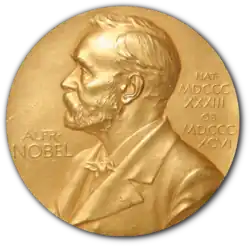
For his creation of the maser, Townes along with Nikolay Basov and Alexander Prokhorov received the 1964 Nobel Prize in Physics.[18] Townes also developed the use of masers and lasers for astronomy, was part of a team that first discovered complex molecules in space, and determined the mass of the supermassive black hole at the center of the Milky Way galaxy.[19][20][21][22][23]
During 2002–2003, Townes served as a Karl Schwarzschild Lecturer in Germany and the Birla Lecturer and Schroedinger Lecturer in India.[2]
Townes is one of the 20 American recipients of the Nobel Prize in Physics to sign a letter addressed to President George W. Bush in May 2008, urging him to "reverse the damage done to basic science research in the Fiscal Year 2008 Omnibus Appropriations Bill" by requesting additional emergency funding for the Department of Energy's Office of Science, the National Science Foundation, and the National Institute of Standards and Technology.[24]
Astrophysics
Galactic Center
The Galactic Center of the Milky Way had long puzzled astronomers, and thick dust obscures the view of it in visible light. During the mid to late 1970s, Townes together with Eric Wollman, John Lacy, Thomas Geballe and Fred Baas studied Sagittarius A, the H II region at the Galactic Center, at infrared wavelengths. They observed ionized neon gas swirling around the center at such velocities that the mass at the very center must be approximately equal to that of 3 million suns.[25] Such a large mass in such a small space implied that the central object (the radio source Sagittarius A*) contains a supermassive black hole. Sagittarius A* was one of the first black holes detected; subsequently its mass has been more accurately determined to be 4.3 million solar masses.
Shapes and sizes of stars
His last major technological creation was the Infrared Spatial Interferometer with Walt Fitelson, Ed Wishnow and others. The project combined three mobile infrared detectors aligned by lasers that study the same star. If each telescope is 10 meters from the other, it creates an impression of a 30-meter lens.[26] Observations of Betelgeuse, a red giant in the shoulder of the constellation Orion, found that it is increasing and decreasing in size at the rate of 1% per year, 15% over 15 years. ISI produces extremely high angular and spatial resolution. The technology is also playing an important role in the search for extraterrestrial life in collaborations with Dan Werthimer of Search for Extraterrestrial Intelligence (SETI).
Personal life and legacy
Townes married Frances H. Brown, an activist for the homeless,[27] during 1941. They lived in Berkeley, California and had four daughters: Linda Rosenwein, Ellen Anderson, Carla Kessler, and Holly Townes.[2] Frances died in 2018 aged 101.
Several places are named after Townes. For example, in his hometown of Greenville, the Charles Townes Center for the Gifted and Talented was named after him, as well as the Charles H. Townes Center at Furman University.
-
 King Gustaf VI Adolf, Frances Townes and Alexander Prokhorov at the Nobel Prize banquet in 1964
 -
 Daughters of Townes in Sweden in 1964
Science and religion
A religious man and a member of the United Church of Christ, Townes believed that "science and religion [are] quite parallel, much more similar than most people think and that in the long run, they must converge".[28] He wrote in a statement after winning the Templeton Prize during 2005: "Science tries to understand what our universe is like and how it works, including us humans. Religion is aimed at understanding the purpose and meaning of our universe, including our own lives. If the universe has a purpose or meaning, this must be reflected in its structure and functioning, and hence in science."[29]
Townes's opinions concerning science and religion were expounded in his essays "The Convergence of Science and Religion", "Logic and Uncertainties in Science and Religion", and his book Making Waves. Townes felt that the beauty of nature is "obviously God-made" and that God created the universe for humans to emerge and flourish. He prayed every day and ultimately felt that religion is more important than science because it addresses the most important long-range question: the meaning and purpose of our lives. Townes's belief in the convergence of science and religion is based on claimed similarities:
- Faith. Townes argued that the scientist has faith much like a religious person does, allowing him/her to work for years for an uncertain result.
- Revelation. Townes claimed that many important scientific discoveries, like his invention of the maser/laser, occurred as a "flash" much more akin to religious revelation than interpreting data.
- Proof. During this century the mathematician Kurt Gödel discovered that there can be no absolute proof in a scientific sense. Every proof requires a set of assumptions, and there is no way to check whether those assumptions are self-consistent because other assumptions would be required.
- Uncertainty. Townes believed that we should be open-minded to a better understanding of science and religion in the future. This will require us to modify our theories, but not abandon them. For example, at the start of the 20th century physics was largely deterministic. But when scientists began studying the quantum mechanics, they realized that indeterminism and chance play a role in our universe. Both classical physics and quantum mechanics are correct and work well within their own bailiwick, and continue to be taught to students. Similarly, Townes believes that growth of religious understanding will modify, but not make us abandon, our classic religious beliefs.
Death
Townes had steadily been active at the UCB campus, visiting and working regularly in the physics department or at the Space Sciences Laboratory past his 99th birthday and only a few months before his death.[30] Townes' health began to decline, and he died on route to the hospital in Oakland, California, on January 27, 2015, at the age of 99.[31][32][33] Reinhard Genzel, a professor of physics at Berkeley, said of Townes: "He was one of the most important experimental physicists of the last century. ... His strength was his curiosity and his unshakable optimism, based on his deep Christian spirituality."[29]
Recognition
Memberships
| Year | Organization | Type | Ref. |
|---|---|---|---|
| 1956 | .svg.png) National Academy of Sciences National Academy of Sciences
|
Member | [34] |
| 1957 | American Academy of Arts and Sciences
|
Member | [35] |
| 1960 |  American Philosophical Society American Philosophical Society
|
Member | [36] |
| 1970 | Optical Society of America
|
Honorary Member | [37] |
| 1976 | .svg.png) Royal Society Royal Society
|
Foreign Member | [38] |
| 1983 | .svg.png) Pontifical Academy of Sciences Pontifical Academy of Sciences
|
Academician | [39] |
Awards
| Year | Organization | Award | Citation | Ref. |
|---|---|---|---|---|
| 1958 | National Academy of Sciences
|
Comstock Prize in Physics | — | [40] |
| 1959 | .svg.png) Institute of Radio Engineers Institute of Radio Engineers
|
IRE Morris Liebmann Memorial Prize[a] | "For fundamental and original contributions to the maser." | [41] |
| 1959 | AAPT
|
Richtmyer Memorial Award | — | [42] |
| 1961 | American Academy of Arts and Sciences
|
Rumford Prize | "For his development of the laser." | [43] |
| 1961 | National Academy of Sciences
|
John J. Carty Award for the Advancement of Science | — | [44] |
| 1961 | — | David Sarnoff Award | "For research in resonance physics leading to major advances in communication technology." | [45] |
| 1962 | Franklin Institute
|
Stuart Ballantine Medal[b] | "For theoretical work on MASER operation." | [46] |
| 1963 | Institute of Physics
|
Thomas Young Medal and Prize[b] | — | [47] |
| 1964 |  Royal Swedish Academy of Sciences Royal Swedish Academy of Sciences
|
Nobel Prize in Physics[c] | "For fundamental work in the field of quantum electronics, which has led to the construction of oscillators and amplifiers based on the maser-laser principle." | [18] |
| 1967 | IEEE
|
IEEE Medal of Honor | "For his significant contributions in the field of quantum electronics which have led to the maser and the laser." | [48] |
| 1968 | Optical Society of America
|
C.E.K. Mees Medal | — | [49] |
| 1969 | American Academy of Achievement
|
Golden Plate Award | — | [50] |
| 1970 |  Austrian Trade Association Austrian Trade Association
|
Wilhelm Exner Medal | – | [51] |
| 1977 | American Physical Society
|
Earle K. Plyler Prize | "For his contributions to the renaissance in optical spectroscopy using maser and laser techniques for obtaining precise and diverse information about numerous molecules; for his part in the initiation of microwave interstellar molecular spectroscopy and for his participation in the first detection of the spectral lines of ammonia and water molecules in outer space." | [52] |
| 1979 |  Danish Society of Engineers Danish Society of Engineers
|
Niels Bohr International Gold Medal | — | [53] |
| 1996 | Optical Society of America
|
Frederic Ives Medal | "For five decades of major contributions to the field of optics, including research, education and administration, but especially for his inspiring creativity in optical physics, from quantum electronics to airborne infrared astronomy." | [54] |
| 2000 |  Russian Academy of Sciences Russian Academy of Sciences
|
Lomonosov Gold Medal[d] | "For fundamental contributions to quantum electronics and microwave spectroscopy." | [55] |
| 2005 | John Templeton Foundation
|
Templeton Prize | — | [56] |
| 2010 | SPIE
|
SPIE Gold Medal | — | [57] |
| 2012 | — | Golden Goose Award | — | [58] |
| 2012 | ASME
|
Nancy DeLoye Fitzroy and Roland V. Fitzroy Medal | — | [59] |
National awards
| Year | Head of state | Award | Citation | Ref. |
|---|---|---|---|---|
| 1982 | Ronald Reagan
|
National Medal of Science | "For fundamental contributions to the understanding of matter through its interaction with electromagnetic radiations and the application of this knowledge to the service of mankind, most notably in the invention of the maser and laser." | [60] |
Selected publications
Townes work was published widely in books and peer-reviewed journal articles,[11] including:
- Gordon, J.; Zeiger, H.; Townes, Charles (1955). "The Maser—New Type of Microwave Amplifier, Frequency Standard, and Spectrometer". Physical Review. 99 (4): 1264–1274. Bibcode:1955PhRv...99.1264G. doi:10.1103/PhysRev.99.1264.
- Shimoda, K.; Wang, T.; Townes, Charles (1956). "Further Aspects of the Theory of the Maser". Physical Review. 102 (5): 1308–1321. Bibcode:1956PhRv..102.1308S. doi:10.1103/PhysRev.102.1308.
- Schawlow, Arthur; Townes, Charles (1958). "Infrared and Optical Masers". Physical Review. 112 (6): 1940–1949. Bibcode:1958PhRv..112.1940S. doi:10.1103/PhysRev.112.1940.
- Townes, Charles (1999). How the Laser Happened: Adventures Of a Scientist. Oxford University Press. ISBN 978-0-19-512268-8.
- Townes, Charles; Schawlow, Arthur (1955). Microwave Spectroscopy. McGraw-Hill. ISBN 978-0-07-065095-4
- Townes, Charles H. (1995). Making Waves. Springer. ISBN 978-1-56396-381-0.
- Townes, Charles H. (November 11, 2004). "Making waves" (PDF). Nature. 432 (7014). doi:10.1038/432153a. ISSN 0028-0836. Retrieved August 15, 2025. (requires subscription)
Notes
- ^ Shared with Nicolaas Bloembergen.
- ^ a b Shared with Arthur Schawlow.
- ^ Shared with Nikolay Basov and Alexander Prokhorov.
- ^ Shared with Andrey Gaponov-Grekhov.
References
- ^ a b c d e f g "Charles Hard Townes". Mathematics Genealogy Project. North Dakota State University. Retrieved April 25, 2026.
- ^ a b c d e f g h i j k l "Charles H. Townes – Biographical". Nobelprize.org. 2006. Archived from the original on July 28, 2014. Retrieved July 29, 2014.
- ^ Staff. "About Charles Townes – Charles H. Townes Lecture Series". www.furman.edu. Furman University. Archived from the original on July 27, 2020. Retrieved May 1, 2020.
- ^ Bertolotti, Mario (2004). The History of the Laser. Taylor & Francis. ISBN 978-0-7503-0911-0.
- ^ Bromberg, Joan (1991). The Laser in America, 1950–1970. MIT Press. ISBN 978-0-585-36732-3.
- ^ Chiao, Raymond, ed. (1996). Amazing Light: A Volume Dedicated To Charles Hard Townes On His 80th Birthday. Springer. ISBN 978-0-387-94658-0.
- ^ Chiao, Raymond, ed. (2005). Visions of Discovery: New Light on Physics, Cosmology, and Consciousness, A Volume Dedicated to Charles Hard Townes on his 90th Birthday. Cambridge. ISBN 978-0-521-88239-2.
- ^ Taylor, Nick (2000). Laser: The Inventor, the Nobel Laureate, and the Thirty-Year Patent War. Simon & Schuster. ISBN 978-0-684-83515-0.
- ^ a b Boyd, Robert (2015). "Dr. Charles H. Townes (1915–2015) Laser co-inventor, astrophysicist and US presidential adviser". Nature. 519 (7543): 292. Bibcode:2015Natur.519..292B. doi:10.1038/519292a. PMID 25788091.
- ^ "Nobel laureate and laser inventor, Charles Hard Townes, dies at 99". Berkeley.edu. January 27, 2015. Archived from the original on January 28, 2015. Retrieved January 27, 2015.
- ^ a b Charles H. Townes's publications indexed by the Scopus bibliographic database. (subscription required)
- ^ Riess, Suzanne B. (1992). "A Life in Physics: Bell Telephone Laboratories and World War II; Columbia University and the Laser; MIT and Government Service; California and Research in Astrophysics". California Digital Library. Archived from the original on February 8, 2023. Retrieved September 4, 2016.
- ^ Stephen Farnsworth (September 10, 2010). "Notable South Carolinians- Dr. Charles Hard Townes". Indigobluesc.com. Archived from the original on October 23, 2013. Retrieved October 22, 2013.
- ^ Aaserud, Finn (May 20, 1987). Charles Townes interview Archived December 22, 2019, at the Wayback Machine. American Institute of Physics
- ^ "Charles Townes". The Array of Contemporary American Physicists. Archived from the original on February 23, 2016. Retrieved December 30, 2015.
- ^ Townes, Charles Hard (1939). Concentration of the Heavy Isotope of Carbon and Measurement of its Nuclear Spin (PhD thesis). doi:10.7907/106Z-3X75.
- ^ Townes, Charles (2002). How the Laser Happened. Oxford University Press. ISBN 978-0195153767.
- ^ a b "Nobel Prize in Physics 1964". Nobel Foundation. Archived from the original on September 17, 2008. Retrieved October 9, 2008.
- ^ "Laser inventor Charles Townes dies". The Guardian. January 29, 2015. Archived from the original on February 26, 2017. Retrieved December 14, 2016.
- ^ Chiao, R.; Garmire, E.; Townes, C. (1964). "Self-Trapping of Optical Beams". Physical Review Letters. 13 (15): 479–482. Bibcode:1964PhRvL..13..479C. doi:10.1103/PhysRevLett.13.479.
- ^ Schawlow, A.; Townes, C. (1958). "Infrared and Optical Masers". Physical Review. 112 (6): 1940–1949. Bibcode:1958PhRv..112.1940S. doi:10.1103/PhysRev.112.1940.
- ^ Autler, S.; Townes, C. (1955). "Stark Effect in Rapidly Varying Fields". Physical Review. 100 (2): 703–722. Bibcode:1955PhRv..100..703A. doi:10.1103/PhysRev.100.703.
- ^ Danchi, W. C.; Bester, M.; Degiacomi, C. G.; Greenhill, L. J.; Townes, C. H. (1994). "Characteristics of dust shells around 13 late-type stars". The Astronomical Journal. 107: 1469. Bibcode:1994AJ....107.1469D. doi:10.1086/116960.
- ^ "A Letter from America's Physics Nobel Laureates" (PDF). pppl.gov. May 6, 2008. Archived (PDF) from the original on October 30, 2021. Retrieved May 31, 2020.
- ^ Genzel, R; Hollenbach, D; Townes, C H (May 1, 1994). "The nucleus of our Galaxy". Reports on Progress in Physics. 57 (5): 417–479. Bibcode:1994RPPh...57..417G. doi:10.1088/0034-4885/57/5/001. ISSN 0034-4885. S2CID 250900662.
- ^ "The UC Berkeley Infrared Spatial Interferometer". isi.ssl.berkeley.edu. U. C. Berkeley. June 10, 2009. Archived from the original on December 15, 2007. Retrieved May 1, 2020.
- ^ "Celebrating the 100th Birthday of Frances H. Townes". Youth Spirit Artworks. January 16, 2016. Archived from the original on March 15, 2016. Retrieved March 14, 2016.
- ^ Harvard Gazette, June 16, 2005 Laser's inventor predicts meeting of science, religion. Archived March 5, 2016, at the Wayback Machine.
- ^ a b Henry, David (January 28, 2015). "Pioneer of James Bond's Laser, Dies at 99". Bloomberg. Archived from the original on October 24, 2018. Retrieved July 22, 2015.
- ^ Sanders, Robert (January 27, 2015). "Nobel laureate and laser inventor Charles Townes dies at 99". Berkeley News. Archived from the original on November 8, 2020. Retrieved November 13, 2020.
- ^ "Inventor of the Laser Dies". Time. Archived from the original on November 8, 2020. Retrieved November 12, 2020.
- ^ McFadden, Robert D. (January 28, 2015). "Charles H. Townes, Who Paved Way for the Laser in Daily Life, Dies at 99". The New York Times. ISSN 0362-4331. Archived from the original on November 19, 2020. Retrieved November 13, 2020.
- ^ Boyd, Robert (March 2015). "Charles H. Townes (1915–2015)". Nature. 519 (7543): 292. Bibcode:2015Natur.519..292B. doi:10.1038/519292a. ISSN 1476-4687. PMID 25788091. S2CID 4384078.
- ^ "Charles Hard Townes". www.nasonline.org. Archived from the original on January 23, 2026. Retrieved March 24, 2026.
- ^ "Charles Hard Townes". www.amacad.org. Archived from the original on January 21, 2026. Retrieved March 24, 2026.
- ^ "APS Member History". search.amphilsoc.org. Archived from the original on November 30, 2022. Retrieved November 28, 2022.
- ^ "Charles Hard Townes". www.optica.org. Archived from the original on December 7, 2025. Retrieved March 24, 2026.
- ^ "Professor Charles Townes ForMemRS". royalsociety.org. Archived from the original on March 14, 2016. Retrieved March 14, 2016.
- ^ "Charles Hard Townes". www.pas.va. Archived from the original on December 14, 2025. Retrieved March 24, 2026.
- ^ "Comstock Prize in Physics". www.nasonline.org. Archived from the original on February 16, 2014. Retrieved February 26, 2014.
- ^ "IEEE Morris N. Liebmann Memorial Award Recipients" (PDF). IEEE. Archived from the original (PDF) on March 3, 2016. Retrieved February 27, 2011.
- ^ "Richtmyer Memorial Lecture Award". www.aapt.org. Archived from the original on December 24, 2016. Retrieved January 28, 2015.
- ^ "Rumford Prize Recipients". www.amacad.org. Archived from the original on October 11, 2025. Retrieved December 4, 2025.
- ^ "John J. Carty Award for the Advancement of Science". www.nasonline.org. Archived from the original on December 29, 2010. Retrieved February 13, 2011.
- ^ "IEEE David Sarnoff Award Recipients" (PDF). IEEE. Archived from the original (PDF) on June 19, 2010. Retrieved December 6, 2011.
- ^ "Charles H. Townes". Franklin Institute. Retrieved March 24, 2026.
- ^ "Thomas Young Medal and Prize recipients". Institute of Physics. Archived from the original on January 4, 2026. Retrieved March 21, 2026.
- ^ "Charles H. Townes". IEEE. Archived from the original on December 1, 2023. Retrieved May 13, 2024.
- ^ "C.E.K. Mees Medal". www.optica.org. Archived from the original on February 14, 2026. Retrieved March 24, 2026.
- ^ "Charles H. Townes, Ph.D." achievement.org. Archived from the original on January 18, 2026. Retrieved March 24, 2026.
- ^ "Charles Hard Townes" (in German). Austrian Trade Association. Archived from the original on August 8, 2020. Retrieved July 29, 2020.
- ^ "Earle K. Plyler Prize for Molecular Spectroscopy & Dynamics". www.aps.org. Archived from the original on November 29, 2025. Retrieved March 24, 2026.
- ^ "French physicist receives the Niels Bohr Medal". bohr2013.nbi.ku.dk. Archived from the original on October 6, 2013. Retrieved December 3, 2013.
- ^ "Frederic Ives Medal / Jarus W. Quinn Prize". www.optica.org. Archived from the original on March 16, 2017. Retrieved October 8, 2018.
- ^ "Большая золотая медаль им. М.В.Ломоносова". www.ras.ru (in Russian). Archived from the original on October 3, 2025. Retrieved November 7, 2025.
- ^ "Laureates". www.templetonprize.org. Archived from the original on February 21, 2026. Retrieved March 24, 2026.
- ^ "SPIE Gold Medal". spie.org. Archived from the original on December 20, 2024. Retrieved January 27, 2020.
- ^ "2012: The MASER". www.goldengooseaward.org. Archived from the original on May 5, 2025. Retrieved March 24, 2026.
- ^ "Nancy DeLoye Fitzroy and Roland V. Fitzroy Medal". www.asme.org. Archived from the original on April 19, 2025. Retrieved June 26, 2025.
- ^ "Charles H. Townes". nationalmedals.org. Archived from the original on January 17, 2026. Retrieved March 24, 2026.
External links
- Charles Townes Oral History part 1 Childhood, college, career overview, Recorded at IEEE History Center, August 1991, Retrieved May 1, 2015
- Charles Townes Oral History part 2 Studies at Caltech and work at Bell Labs on the eve of World War II, Recorded at IEEE History Center, September 1992, Retrieved May 1, 2015
- The Learning Project Charles Hard Townes, physicist, astronomer, university professor. Interview for The Learning Project: Views of Authentic Learning, June 2005
- Charles H. Townes, Ph.D., Biography and Interview with American Academy of Achievement
- Charles H. Townes on Nobelprize.org including the Nobel Lecture, December 11, 1964 Production of Coherent Radiation by Atoms and Molecules
- Massachusetts Institute of Technology, Office of the Provost, Records of Charles H. Townes, AC-0031. Department of Distinctive Collections, Massachusetts Institute of Technology, Cambridge, Massachusetts.
- P. Buford Price and Reinhard Genzel, "Charles H. Townes", Biographical Memoirs of the National Academy of Sciences (2016)