Cylinder seal


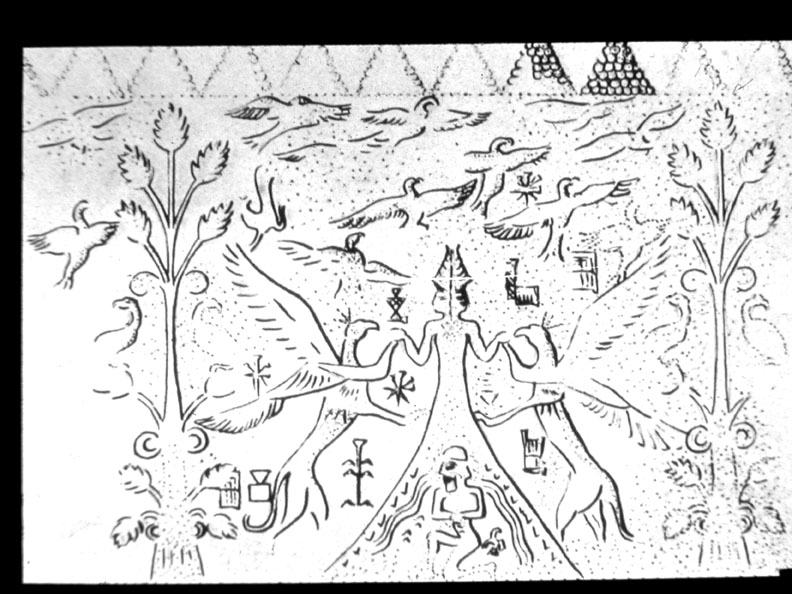
A cylinder seal is a small round cylinder, typically about one inch (2 to 3 cm) in width, engraved with written characters or figurative scenes or both, used in ancient times to roll an impression onto a two-dimensional surface, generally wet clay. Cylinder seals were invented around 3500 BC in the Near East, at the contemporary sites of Uruk in southern Mesopotamia and slightly later at Susa in south-western Iran during the Proto-Elamite period, and they follow the development of stamp seals in the Halaf culture or slightly earlier.[4] They are linked to the invention of the latter's cuneiform writing on clay tablets.[5][6]
Cylinder seals are a form of impression seal, a category which includes the stamp seal and finger ring seal. They survive in fairly large numbers and are important as art, especially in the Babylonian and earlier Assyrian periods. Impressions into a soft material can be taken without risk of damage to the seal, and they are often displayed in museums together with a modern impression on a small strip.
Materials
The cylinder seals themselves are typically made from hardstones, and some are a form of engraved gem. They may also use glass or ceramics, like Egyptian faience. Many varieties of material such as hematite, obsidian, steatite, amethyst, lapis lazuli and carnelian were used to make cylinder seals. As the alluvial country of Mesopotamia lacks good stone for carving, the large stones of early cylinders were imported probably from Iran.[6] Most seals have a hole running through the centre of the body, and they are thought to have typically been worn on a necklace to be always available when needed.
.jpg)
(modern/current impressions)
Uses
Cylinder-seal impressions served as an administrative tool, a form of signature,[7] and for product branding.[8] The cylinders themselves functioned as jewellery and as magical amulets;[7] later versions would employ notations with Mesopotamian cuneiform. In later periods, they were used to notarize or attest to multiple impressions of clay documents. Graves and other sites housing precious items such as gold, silver, beads, and gemstones often included one or two cylinder seals, as honorific grave goods.
Most Mesopotamian cylinder seals form an image using depressions in the cylinder surface to make bumps on the impression and are used primarily on wet clay. Some cylinder seals (sometimes called roller stamps) print images using ink or similar using raised areas on the cylinder (such as the San Andrés cylinder seal, found not in Mesopotamia but in an Olmec archaeological site in the present-day Mexican state of Tabasco)[9] and produce images on cloth and other similar two-dimensional surfaces.
Cylinder seal impressions appear on a variety of surfaces:
- amulets
- bales of commodities
- bricks
- clay tablets
- cloth
- components of fabricated objects
- doors
- envelopes
- storage jars

Theme-driven, memorial, and commemorative nature

The images depicted on cylinder seals were mostly theme-driven and often sociological or religious. Instead of addressing the authority of the seal, a better study may be of the thematic nature of the seals, since they presented the ideas of the society in pictographic and text form. In a famous cylinder depicting Darius I of Persia: he is aiming his drawn bow at an upright enraged lion impaled by two arrows, while his chariot horse is trampling a dead lion. The scene is framed between two slim palm trees and a block of cuneiform text and, above the scene, the Faravahar symbol of Ahura Mazda, the god representation of Zoroastrianism.
Categories of seals
There are several categories of cylinder seals:
- Assyrian cylinder seals[11]: 68
- Neo-Assyrian cylinder seals[11]: 45
- Cypriote cylinder seals
- Egyptian cylinder seals
- Predynastic Egyptian Naqada era tombs and graves (imported)
- Egyptian Faience[13]
- Hittite cylinder seals
- Kassite cylinder seals
- Mesoamerican seals[9][15]
- Mittanian cylinder seals[11]: 97
- Old Babylonian cylinder seals[11]: 43
- Persian cylinder seals[16]
- Proto-Elamite cylinder seals[11]: 72
- Sumerian cylinder seals[11]
- Seals of the "Moon-God"
- Seal of Ur-Nammu 2112-2095 BC[16][17]
- Shamash pictographic seals; see Mari, Syria
- Pre-dynastic seals[11]: 13–14
- Neo-Sumerian cylinder seals[11]: 40
- Syrian cylinder seals[11]: 101
See also


- Ancient Near Eastern seals and sealing practices
- Seal (device)
- Impression seal
- Stamp seal
- LMLK seal
- Mudbrick stamp
- Scaraboid seal
References
- ^ British Museum notice WA 121544
- ^ Crawford, Harriet (2013). The Sumerian World. Routledge. p. 622. ISBN 9781136219115.
- ^ Anthropology, University of Pennsylvania Museum of Archaeology and; Hansen, Donald P.; Pittman, Holly (1998). Treasures from the Royal Tombs of Ur. UPenn Museum of Archaeology. p. 78. ISBN 9780924171550.
- ^ Brown, Brian A.; Feldman, Marian H. (2013). Critical Approaches to Ancient Near Eastern Art. Walter de Gruyter. p. 304. ISBN 9781614510352.
- ^ "Mesopotamian cylinder seals". The British Museum. Archived from the original on 11 December 2007.
- ^ a b Porada, Edith (1993). "Why Cylinder Seals? Engraved Cylindrical Seal Stones of the Ancient Near East, Fourth to First Millennium B.C." The Art Bulletin. 75 (4): 563–582. doi:10.2307/3045984. ISSN 0004-3079.
- ^ a b "Ancient Cylinder Seals". Johns Hopkins Archaeological Museum. Johns Hopkins University. Archived from the original on 30 June 2019. Retrieved 23 April 2023.
- ^
Greenberg, Raphael (7 November 2019). "Urbanism and Its Demise in the Early Bronze II and III". The Archaeology of the Bronze Age Levant: From Urban Origins to the Demise of City-States, 3700-1000 BCE. Cambridge World Archaeology. Cambridge: Cambridge University Press. p. 92. ISBN 9781107111462. Retrieved 23 April 2023.
[...] cylinder-seal impressions appeared randomly on ceramic vessels, especially on pithoi manufactured in the region [...] the seal-impression is the mark of the fabricant, intended to brand the vessel [...].
- ^ a b Pohl, Mary E. D.; Pope, Kevin O.; von Nagy, Christopher (6 December 2002). "Olmec Origins of Mesoamerican Writing". Science. 298 (5600): 1984–1987. doi:10.1126/science.1078474.
- ^ "Cylinder Seal with a Nude Goddess". The Walters Art Museum Online Collection.
- ^ a b c d e f g h i j Garbini, Giovanni (1966). The Ancient World. Landmarks of the World's Art. New York; Toronto: McGraw-Hill.
- ^ National Geographic Society (U.S.) Book Division, ed. (1994). "Origins of Writing". Wonders of the ancient world: National Geographic Atlas of Archaeology. Washington, D.C: The National Geographic Society. p. 71. ISBN 978-0-87044-983-3.
- ^ "Cylinder seal of Pepy I". The Global Egyptian Museum. Archived from the original on 14 March 2007. Retrieved 23 April 2026.
- ^ Strupler, Néhémie (2021). "An Overview of Sealing Practices at Kültepe" (PDF). Cultural Exchange and Current Research in Kültepe and its Surroundings Kültepe. Turnhout: Brepols. pp. 181–196. Archived (PDF) from the original on 11 September 2024. Retrieved 5 September 2024.
- ^ Kelley, David H. (1966). "A Cylinder Seal from Tlatilco". American Antiquity. 31 (5Part1): 744–746. doi:10.2307/2694503. ISSN 0002-7316.
- ^ a b Robinson, Andrew (1995). "Chapter 4 Cuneiform". The story of writing. New York: Thames and Hudson. p. 70. ISBN 978-0-500-01665-7.
- ^ "Object: Hash-hamer Cylinder". British Museum. Retrieved 23 April 2026.
Further reading
- Bahn, Paul. Lost Treasures, Great Discoveries in World Archaeology, Ed. by Paul G. Bahn, (Barnes and Noble Books, New York), c 1999.
- Collon, Dominique. First Impressions, Cylinder Seals in the Ancient Near East, (British Museum Press, London), 1987, 2005.
- Collon, Dominique. Near Eastern Seals, (British Museum, London), 1990. Part of the BM's Interpreting the Past series
- Frankfort, H. Cylinder Seals, 1939, London.
- Metropolitan Museum of Art. Cuneiform Texts in the Metropolitan Museum of Art: Tablets, Cones, and Bricks of the Third and Second Millennia B.C., vol. 1 (New York, 1988). The final section (Bricks) of the book concerns cylinder seals, with a foreword describing the purpose of the section as to instigate research into cylinder Seals.
- Metropolitan Museum of Art. Ancient Near Eastern Art, (Reprint), Metr. Mus. of Art Photograph Studio, Designed, Alvin Grossman, Photography, Lynton Gardiner, (Metropolitan Museum of Art Bulletin (Spring 1984)), c 1984. 56pgs.
- Metropolitan Museum of Art. Beyond Babylon, Art, Trade and Diplomacy in the Second Millennium BC, ed. Joan Aruz. 2008.
External links

- Seals on the Persepolis Fortification Tablets Archived 25 March 2013 at the Wayback Machine - by Mark B. Garrison and Margaret C. Root, at the Oriental Institute webpage
- Kassite, Seal Impression, Department of the History of Art, University of Pennsylvania
- Seal impressions-(High Res), (1 Seal), God/Symbols explanations.
- 3D development simulation of the Cylinder Seal of Ibni Sharrum by D. Pitzalis on YouTube.