Euthycarcinoidea
| Euthycarcinoidea Temporal range:
| |
|---|---|

| |
| Life restoration of Apankura | |

| |
| Life restoration of Sottyxerxes | |
Scientific classification 
| |
| Kingdom: | Animalia |
| Phylum: | Arthropoda |
| (unranked): | Deuteropoda |
| Clade: | Mandibulata |
| Subclass: | †Euthycarcinoidea Gall & Grauvogel, 1964 |
| Order: | †Euthycarcinida Gall & Grauvogel, 1964 |
| Genera | |
|
See text | |
Euthycarcinoidea are a group of extinct, possibly amphibious arthropods that ranged from the Cambrian to the Triassic.[1] Fossils are known from Europe, North America, Argentina, Australia, and Antarctica. While previously considered enigmatic, they are now widely considered to be members of Mandibulata, and possibly the closest known relatives of Myriapoda (which contains millipedes and centipedes, among others).
Description
The euthycarcinoid body was divided into a cephalon (head), preabdomen, and postabdomen. The cephalon consisted of two segments and included mandibles, antennae and presumed eyes. The preabdomen consisted of five to fourteen tergites, each having up to three somites. Each somite had in turn a pair of uniramous, segmented legs. The postabdomen was limbless and consisted of up to six segments and a terminal tail spine.[2]

Affinities
Due to its particular combination of characteristics, the position of the Euthycarcinoidea within the Arthropoda has been ambiguous; previous authors have allied euthycarcinoids with crustaceans (interpreted as copepods, branchiopods, or an independent group), with trilobites, or the merostomatans (horseshoe crabs and sea scorpions, now an obsolete group[4]).[5] However, due to the general features and the discovery of fossils from this group in Cambrian rocks, a 2010 study suggested that they may have given rise to the mandibulates, the group that includes the myriapods (centipedes, millipedes and the like), crustaceans, and hexapods (insects, etc.).[2]
|
| |||||||
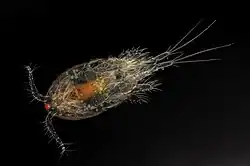
However, a 2020 study identified several characters, including compound eyes and various details of the preoral chamber, that suggested instead a position as the closest relatives of living myriapods.[6] This would help to close the gap between the earliest body fossils of crown-group myriapods in the Silurian and molecular clock data suggesting a divergence from their closest relatives during the Ediacaran or Cambrian.[2] This had already been suggested by the cladogram of a previous study.[7] Cladogram of Mandibulata after Laville et al. (2025), showing proposed position of Euthycarcinida as sister to Myriapodia:[8]
| Mandibulata |
| ||||||||||||||||||||||||||||||||||||||||||||||||||||||||||||||||||||||||||||||||||||||||||||||||||||||||||||||||||||||||


.jpeg)




Environment and life habits
Euthycarcinoid fossils have been found in marine, brackish and freshwater deposits.[2] Taxa from the Cambrian are from marine or intertidal sediments, while all specimens from the Ordovician to the Triassic are freshwater or brackish.[5] Fossil impressions of euthycarcinoid postabdomens in association with Protichnites trackways in Cambrian intertidal/supratidal deposits also suggest that euthycarcinoids may have been the first arthropods to walk on land.[9][10] It has been suggested that the biofilms and microbial mats that covered much of the vast tidal flats during the Cambrian Period in North America may have provided the nourishment that lured these arthropods onto the land.[11] Fossil evidence also suggests the possibility that some euthycarcinoids came onto the land to lay and fertilize their eggs via amplexus, as do the modern horseshoe crabs.[10]
Classification
The known species of euthycarcinoids and their distribution were reviewed by Racheboeuf et al. in 2008. Additional species were described by Collette and Hagadorn in 2010.[5][9][12]
| Family | Family authority | Genus | Genus authority | Species | Species authority | Age | Type of deposits | Location of deposits |
|---|---|---|---|---|---|---|---|---|
| Euthycarcinidae | Handlirsch, 1914 | Euthycarcinus | Handlirsch, 1914 | E. ibbenburensis | Schultka, 1991 | Pennsylvanian: Westphalian | Freshwater | Germany |
| E. kessleri | Handlirsch, 1914 | Triassic | Freshwater | France | ||||
| E. martensi | Schneider, 1983 | Permian | Freshwater | Germany | ||||
| Synaustrus | Riek, 1964 | S. brookvalensis | Riek, 1964 | Triassic | Freshwater | Australia | ||
| Kottixerxidae | Starobogatov, 1988 | Heterocrania | Hirst & Maulik, 1926 | H. rhyniensis | Hirst & Maulik, 1926 | Lower Devonian[13] | Freshwater[13] | United Kingdom[13] |
| Kalbarria | McNamara & Trewin, 1993 | K. brimmellae | McNamara & Trewin, 1993 | Ordovician or Late Silurian (age is controversial)[14] | Freshwater (habitat is controversial)[14] | Australia | ||
| Kottixerxes | Schram, 1971 | K. anglicus | Wilson & Almond, 2001 | Pennsylvanian: Westphalian | Brackish to freshwater | United Kingdom | ||
| K. gloriosus | Schram, 1971 | Pennsylvanian: Westphalian | Brackish to freshwater | United States | ||||
| Schramixerxes | Starobogatov, 1988 | S. gerem | (Schram & Rolfe, 1982) | Late Pennsylvanian: Stephanian | Freshwater | France | ||
| Smithixerxes | Schram & Rolfe, 1982 | S. juliarum | Schram & Rolfe, 1982 | Pennsylvanian: Westphalian | Brackish to freshwater | United States | ||
| S. pustulosus | Wilson & Almond, 2001 | Pennsylvanian: Westphalian | Brackish to freshwater | United Kingdom | ||||
| Mictomeridae | Collette & Hagadorn, 2010[9] | Mictomerus | Collette & Hagadorn, 2010[9] | M. melochevillensis | Collette & Hagadorn, 2010[9] | Cambrian | Intertidal | Canada |
| incertae sedis | Antarcticarcinus | Collette, Isbell & Miller, 2017[15] | A. pagoda | Collette, Isbell & Miller, 2017[15] | Upper Carboniferous to Lower Permian | Pagoda Formation, Antarctica[15] | ||
| Apankura | Vaccari, Edgecombe & Escudero, 2004[16] | A. machu | Vaccari, Edgecombe & Escudero, 2004[16] | Cambrian | Marine | Argentina | ||
| Ericixerxes | Gueriau, Lamsdell, Wogelius, Manning, Egerton, Bergmann, Bertrand & Denayer, 2020 | E. potii | Gueriau, Lamsdell, Wogelius, Manning, Egerton, Bergmann, Bertrand & Denayer, 2020 | Upper Devonian | Brackish | Belgium | ||
| Mosineia | Collette & Hagadorn, 2010[9] | M. macnaughtoni | Collette & Hagadorn, 2010[9] | Cambrian | Intertidal | United States | ||
| Pieckoxerxes | Starobogatov, 1988 | P. pieckoae | (Schram & Rolfe, 1982) | Pennsylvanian: Westphalian | Brackish to freshwater | United States | ||
| Sottyxerxes | Schram & Rolfe, 1982 | S. multiplex | Schram & Rolfe, 1982 | Late Pennsylvanian: Stephanian | Freshwater | France |
References
- ^ A new Devonian euthycarcinoid reveals the use of different respiratory strategies during the marine-to-terrestrial transition in the myriapod lineage
- ^ a b c d Ortega-Hernández, Javier; Legg, David A.; Tremewan, Jonathan; Braddy, Simon J. (2010). "Euthycarcinoids". Geology Today. 26 (5): 195–198. doi:10.1111/j.1365-2451.2010.00770.x. ISSN 1365-2451.
- ^ McNamara, Kenneth J.; Trewin, Nigel H. (1993). "A euthycarcinoid arthropod from the Silurian of Western Australia". Palaeontology. 36: 319–335.
- ^ Lamsdell, James C. (2012-12-18). "Revised systematics of Palaeozoic 'horseshoe crabs' and the myth of monophyletic Xiphosura". Zoological Journal of the Linnean Society. 167 (1): 1–27. doi:10.1111/j.1096-3642.2012.00874.x. ISSN 0024-4082.
- ^ a b c Racheboeuf, Patrick R.; Vannier, Jean; Schram, Frederick R.; Chabard, Dominique; Sotty, Daniel (2008). "The euthycarcinoid arthropods from Montceau-les-Mines, France: functional morphology and affinities" (PDF). Earth and Environmental Science Transactions of the Royal Society of Edinburgh. 99 (1): 11–25. doi:10.1017/S1755691008006130. S2CID 59123727.
- ^ Edgecombe, Gregory D.; Strullu-Derrien, Christine; Góral, Tomasz; Hetherington, Alexander J.; Thompson, Christine; Koch, Marcus (2020). "Aquatic stem group myriapods close a gap between molecular divergence dates and terrestrial fossil record". Proceedings of the National Academy of Sciences. 117 (16): 8966–8972. doi:10.1073/pnas.1920733117. PMC 7183169. PMID 32253305. S2CID 215408474.
- ^ Vannier, Jean; Aria, Cédric; Taylor, Rod S.; Caron, Jean-Bernard (June 2018). "Waptia fieldensis Walcott, a mandibulate arthropod from the middle Cambrian Burgess Shale". Royal Society Open Science. 5 (6) 172206. doi:10.1098/rsos.172206. ISSN 2054-5703. PMC 6030330. PMID 30110460.
- ^ Laville, Thomas; Forel, Marie-Béatrice; King, Andrew; Charbonnier, Sylvain (2025-11-01). "Synchrotron X-ray tomography sheds light on the phylogenetic affinities of the enigmatic thylacocephalans within Pancrustacea". Proceedings of the Royal Society B: Biological Sciences. 292.
- ^ a b c d e f g Collette, Joseph H.; Hagadorn, James W. (July 2010). "Three-dimensionally preserved arthropods from Cambrian Lagerstätten of Quebec and Wisconsin". Journal of Paleontology. 84 (4): 646–667. doi:10.1666/09-075.1. ISSN 0022-3360.
- ^ a b Collette, Joseph H.; Gass, Kenneth C.; Hagadorn, James W. (May 2012). "Protichnites eremita unshelled? Experimental model-based neoichnology and new evidence for a euthycarcinoid affinity for this ichnospecies". Journal of Paleontology. 86 (3): 442–454. doi:10.1666/11-056.1. ISSN 0022-3360.
- ^ MacNaughton, Robert B.; Cole, Jennifer M.; Dalrymple, Robert W.; Braddy, Simon J.; Briggs, Derek E.G.; Lukie, Terrence D. (2002). "First steps on land: Arthropod trackways in Cambrian-Ordovician eolian sandstone, southeastern Ontario, Canada". Geology. 30 (5): 391. doi:10.1130/0091-7613(2002)030<0391:FSOLAT>2.0.CO;2. ISSN 0091-7613.
- ^ "Euthycarcinoidea". Catalogue of Life. Species 2000: Leiden, the Netherlands. Retrieved 14 January 2026.
- ^ a b c Anderson, Lyall I.; Trewin, Nigel H. (2003). "An Early Devonian arthropod fauna from the Windyfield cherts, Aberdeenshire, Scotland". Palaeontology. 46 (3): 467–509. doi:10.1111/1475-4983.00308. ISSN 1475-4983.
- ^ a b Cite error: The named reference
:0was invoked but never defined (see the help page). - ^ a b c Collette, Joseph H.; Isbell, John L.; Miller, Molly F. (September 2017). "A unique winged euthycarcinoid from the Permian of Antarctica". Journal of Paleontology. 91 (5): 987–993. doi:10.1017/jpa.2017.28. ISSN 0022-3360.
- ^ a b Vaccari, N. E.; Edgecombe, G. D.; Escudero, C. (July 2004). "Cambrian origins and affinities of an enigmatic fossil group of arthropods". Nature. 430 (6999): 554–557. doi:10.1038/nature02705. ISSN 1476-4687.