Inola, Oklahoma
Inola, Oklahoma | |
|---|---|
| Nickname: Hay Capital of the World | |
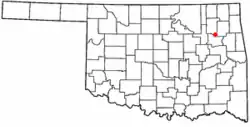 Location of Inola, Oklahoma | |
| Coordinates: 36°08′53″N 95°31′29″W / 36.14806°N 95.52472°W | |
| Country | United States |
| State | Oklahoma |
| County | Rogers |
| Area | |
• Total | 6.75 sq mi (17.47 km2) |
| • Land | 6.68 sq mi (17.30 km2) |
| • Water | 0.069 sq mi (0.18 km2) |
| Elevation | 574 ft (175 m) |
| Population (2020) | |
• Total | 1,890 |
| • Density | 283.0/sq mi (109.27/km2) |
| Time zone | UTC-6 (Central (CST)) |
| • Summer (DST) | UTC-5 (CDT) |
| ZIP code | 74036 |
| Area codes | 539/918 |
| FIPS code | 40-37100[3] |
| GNIS feature ID | 2412794[2] |
| Website | http://www.inolaok.com |
- Inola is also a spider genus (Pisauridae).
Inola is a town in Rogers County, Oklahoma, United States. It is included in the Tulsa Metropolitan Statistical Area (TMSA). As of the 2020 census, Inola had a population of 1,890.[4] Inola is a Cherokee word meaning "Black Fox."[5] The town styles itself as "The Hay Capital of the World."[6]
History
In 1889, the Kansas and Arkansas Valley Railway (later acquired by the Missouri Pacific Railway) built a line from Wagoner through the Foyil area onto the Kansas state line. The area was then just inside the northeastern corner of the Creek Nation in Indian Territory. A post office was established in March 1890 with the name Foyil. It was closed in September 1890 but reopened in April 1891. By 1901, the population was estimated at 100 people. The Dawes Commission had the town platted in 1902, before the Creek allotment.[5]
Strip mines began producing coal nearby before statehood in 1907, causing a small boom in population. Inola's population was 405 in 1920. As the coal industry began to decline, so did the town's population. The 1930 census reported only 399 residents. The decline continued through the post World War II era, reaching 294 in 1950. A turnaround began in the 1950s as residents began commuting to Tulsa. Inola's population grew to 584 in 1960 and 984 in 1970. The 1980 census showed 1,550 residents, increasing to 1,589 in 2000 and 1,788 in 2010.[5]
Geography
According to the United States Census Bureau, the town has a total area of 6.6 square miles (17 km2), of which 6.5 square miles (17 km2) is land and 0.1 square miles (0.26 km2) (0.91%) is water.
Demographics
| Census | Pop. | Note | %± |
|---|---|---|---|
| 1910 | 405 | — | |
| 1920 | 498 | 23.0% | |
| 1930 | 398 | −20.1% | |
| 1940 | 395 | −0.8% | |
| 1950 | 294 | −25.6% | |
| 1960 | 584 | 98.6% | |
| 1970 | 948 | 62.3% | |
| 1980 | 1,550 | 63.5% | |
| 1990 | 1,444 | −6.8% | |
| 2000 | 1,589 | 10.0% | |
| 2010 | 1,788 | 12.5% | |
| 2020 | 1,890 | 5.7% | |
| U.S. Decennial Census[7] | |||
2020 census
As of the 2020 census, Inola had a population of 1,890. The median age was 34.6 years. 28.8% of residents were under the age of 18 and 14.4% of residents were 65 years of age or older. For every 100 females there were 87.9 males, and for every 100 females age 18 and over there were 87.2 males age 18 and over.[8][9]
0.0% of residents lived in urban areas, while 100.0% lived in rural areas.[10]
There were 682 households in Inola, of which 41.5% had children under the age of 18 living in them. Of all households, 49.9% were married-couple households, 16.0% were households with a male householder and no spouse or partner present, and 26.7% were households with a female householder and no spouse or partner present. About 20.4% of all households were made up of individuals and 10.2% had someone living alone who was 65 years of age or older.[8]
There were 773 housing units, of which 11.8% were vacant. The homeowner vacancy rate was 1.5% and the rental vacancy rate was 13.7%.[8]
| Race | Number | Percent |
|---|---|---|
| White | 1,353 | 71.6% |
| Black or African American | 12 | 0.6% |
| American Indian and Alaska Native | 219 | 11.6% |
| Asian | 7 | 0.4% |
| Native Hawaiian and Other Pacific Islander | 0 | 0.0% |
| Some other race | 8 | 0.4% |
| Two or more races | 291 | 15.4% |
| Hispanic or Latino (of any race) | 62 | 3.3% |
Economy
The town has emerged as a bedroom community for Tulsa, about 28 miles to the west.[5]
In October 2020, tissue paper maker Sofidel opened a $360 million production factory in Inola.[11] The 1.8 million-square-foot plant includes a mill that transforms pulp into paper and a conversion facility that makes the finished product.[11] The factory employs more than 300 people, and this number is expected to double with a second operational phase.[11]
Black Fox Power Plant
The Black Fox Nuclear Power Plant was a nuclear power plant proposed by the Public Service Company of Oklahoma (PSO) in May 1973. The facility was to be built approximately 3 miles (4.8 km) outside of Inola and encompass the use of two General Electric (GE) Boiling Water Reactors. PSO argued that there would be great economic growth and better schools in the town. Many residents as well as outsiders were convinced that it would be dangerous to locate such a facility in their backyards. After nine years of court battles and minor earthquakes in the area, the decision was abandoned in 1982 and no complex was built.[5]
References
- ^ "ArcGIS REST Services Directory". United States Census Bureau. Retrieved September 20, 2022.
- ^ a b U.S. Geological Survey Geographic Names Information System: Inola, Oklahoma
- ^ "U.S. Census website". United States Census Bureau. Retrieved January 31, 2008.
- ^ "2020 Decennial Census Redistricting Data (Public Law 94-171)". United States Census Bureau. 2021. Retrieved February 2, 2026.
- ^ a b c d e Larry O'Dell, "Inola" Encyclopedia of Oklahoma History and Culture Accessed March 19, 2012.[1] Archived November 19, 2012, at the Wayback Machine
- ^ "Inola: A Country Way of Life". Inola Chamber of Commerse. Archived from the original on June 18, 2008. Retrieved June 26, 2008.
- ^ "Census of Population and Housing". Census.gov. Retrieved June 4, 2015.
- ^ a b c "2020 Decennial Census Demographic Profile (DP1)". United States Census Bureau. 2021. Retrieved April 25, 2026.
- ^ a b "2020 Decennial Census Redistricting Data (Public Law 94-171)". United States Census Bureau. 2021. Retrieved April 25, 2026.
- ^ "2020 Decennial Census Demographic and Housing Characteristics (DHC)". United States Census Bureau. 2023. Retrieved April 25, 2026.
- ^ a b c "Tissue paper manufacturer Sofidel formally announces opening of plant in Inola". Tulsa World, October 6, 2020. Retrieved October 6, 2020.
External links
- - Inola Public Schools
- Encyclopedia of Oklahoma History and Culture - Inola
- Official Inola, OK website
| Counties |  | |
|---|---|---|
| Principal city | ||
| Cities over 20k | ||
| Cities 10k-20k | ||
| Cities 5k-10k | ||
| Cities and towns 1k-5k | ||
Municipalities and communities of Rogers County, Oklahoma, United States | ||
|---|---|---|
| Cities |  | |
| Towns | ||
| CDPs |
| |
| Other communities |
| |
| Indian reservations | ||
| Footnotes | ‡This populated place also has portions in an adjacent county or counties | |
| ||