Modern Greek architecture
After the Fall of Constantinople to the Ottomans and the following trends of Greek migration to the Diaspora, Greek architecture was concentrated mainly on the Greek Orthodox churches of the Diaspora. These churches, such as other intellectual centres built by Greeks (foundations, schools, etc.), were used also as a meeting-place. The architectural style of these buildings was heavily influenced by the western European architecture.
After the Greek War of Independence and the creation of the modern Greek state, the modern Greek architecture tried to combine the traditional Greek architecture and Greek elements and motives with the western European movements and styles.
The 19th-century architecture of Athens and other cities of the Greek Kingdom is mostly influenced by the Neoclassical architecture, with architects such as Theophil Hansen, Ernst Ziller, Panagis Kalkos, Lysandros Kaftanzoglou and Stamatios Kleanthis.
History
Venetian and Ottoman architecture
The architecture of the modern Greek cities, especially the old centres ("old towns") is mostly influenced either by the Ottoman or the Venetian architecture, two forces that dominated the Greek space from the early modern period. The most notable examples of Gothic architecture in modern-day Greece include the former Dominican church of St. Peter in Heraklion and the Palace of the Grand Master of the Knights of Rhodes in Rhodes, whilst the Venetian Loggia in Heraklion is a prime example of Renaissance architecture. Ottoman architecture is represented by the Alaca Imaret Mosque in Thessaloniki, the former Tzistarakis Mosque in Athens, and the Saint Titus Cathedral in Heraklion.
-
 Former Dominican church of St. Peter in Heraklion (13th century)
 -
 Venetian Loggia in Heraklion (17th century)
 -
 Alaca Imaret Mosque in Thessaloniki (1480s)
 -
 Former Tzistarakis Mosque, now Museum of Greek Folk Art in Athens (1759)
 -
 Former Yeni Cami ("New Mosque"), now Saint Titus Cathedral in Heraklion (1869)
 -
 Palace of the Grand Master of the Knights of Rhodes in Rhodes (14th century)
Neoclassical architecture

After the Greek Independence, the modern Greek architects tried to combine traditional Greek and Byzantine elements and motives with the western European movements and styles. Patras was the first city of the modern Greek state to develop a city plan. In January 1829, Stamatis Voulgaris, a Greek engineer of the French army, presented the plan of the new city to the Governor Kapodistrias, who approved it. Voulgaris applied the orthogonal rule in the urban complex of Patras. However his initial plan was modified in 1830.
Two special genres can be considered the Cycladic architecture, featuring whitewashedhouses, in the Cyclades and the Epirotic architecture in the region of Epirus, featuring stone houses.
After the establishment of the Greek Kingdom, the architecture of Athens and other cities was mostly influenced by the Neoclassical architecture. For Athens, the first King of Greece, Otto of Greece, commissioned the architects Stamatios Kleanthis and Eduard Schaubert to design a modern city plan fit for the capital of a state.
-
 Old Royal Palace in Athens by Friedrich von Gärtner (1843)
 -
 The Academy of Athens by Theophil Hansen (1859)
 -
 The University of Athens by Christian Hansen (1859)
 -
.jpg) The National Library by Theophil Hansen (1888)
The National Library by Theophil Hansen (1888) -
 Zappeion in Athens by Theophil Hansen (1888)
 -
 The Apollon Theatre of Patras, designed by Ernst Ziller (1872)
 -
 Athens City Hall (1874) by Panagis Kalkos
 -
 Old Parliament House, Athens (1875) by Panagis Kalkos/François Boulanger
 -

-
 Municipal Theatre of Piraeus (1895)
 -
 Zosimaia School building, Ioannina (1905)
 -
_%CE%9C%CE%B7%CF%84%CF%81%CE%BF%CF%80%CF%8C%CE%BB%CE%B5%CF%89%CF%82%252C_%CE%98%CE%B5%CF%83%CF%83%CE%B1%CE%BB%CE%BF%CE%BD%CE%AF%CE%BA%CE%B7.jpg) National Bank of Greece in Thessaloniki (1928)
National Bank of Greece in Thessaloniki (1928) -
 Prefecture of Lesbos (early 20th)
 -
.jpg) Government House, Thessaloniki (1960)
Government House, Thessaloniki (1960)
Neo-Byzantine architecture
Another important style was the Neo-Byzantine style, in which many churches were built. The most notable examples include the Cathedral of Saint Andrew in Patras, the Greek-Catholic Cathedral of Athens and the Cathedral of Saint Nectarios of Aegina.
In 1917 most of Thessaloniki's old center of the city was destroyed by the Great Thessaloniki Fire of 1917. Following the fire the government prohibited quick rebuilding, so it could implement the new redesign of the city according to the European-style urban plan prepared by a commission of architects headed by French architect Ernest Hébrard. The main square is Aristotle Square, which is lined with Neo-Byzantine buildings.
-
 Cathedral of Saint Andrew in Patras (1908–74)
 -
.jpg) Cathedral of Saint Andrew in Patras, interior
Cathedral of Saint Andrew in Patras, interior -
.jpg) Greek-Catholic Cathedral of Athens (1932)
Greek-Catholic Cathedral of Athens (1932) -
 Church of Saint Panteleimon of Acharnai in Athens (1930)
 -
 Hagia Triada Cathedral, Piraeus (1956–79)
 -
 Hagia Triada Cathedral, Piraeus, interior
 -
 Cathedral of Saint Nectarios of Aegina
 -
.jpg) Aristotelous Square in Thessaloniki
Aristotelous Square in Thessaloniki -
 Kaplaneios School in Neo-Byzantine style, Ioannina
Antiparochi laws
In 1929, two important laws concerning apartment buildings took effect. The law about "horizontal property" made it possible that many different owners own one apartment building, each by owning one or more apartment units. Theoretically, each apartment corresponds to a percentage of the original plot. The most important effect of this law was the practice of "αντιπαροχή" (antiparochí, literally "a supply in exchange"). With antiparochí, the owner of a plot, who can't afford to build an apartment building by himself, makes a contract with a construction company so that the latter will build the apartment building but keep the ownership of as many apartments as the contract states. Although during the inter-war period the practice of antiparochí was limited, as the construction of most apartment buildings was financed solely by the original owners of the plot, antiparochí became the most common method for financing the construction of condominiums (polykatoikíes) from the 1950s onwards.[1] However this practice had the negative effect of the destruction of many old-era (mostly of 19th century) buildings and mansions in the major Greek cities, to be replaced by common apartment buildings. Even today (2019), the owners of old buildings or mansions, listed as architecturally preserved, prefer to let them collapse to avoid the preservation cost and exploit the plot.
Italian fascist architecture
Within the borders of modern Greece, there are also works by Italian architects in the Dodecanese, which were ruled by Italy from 1912 to 1947. The most notable examples are Palazzi del Governo in Rhodes and Kos.
-
 Palazzo del Governo (today the offices of the Prefecture of the Dodecanese) in Rhodes by Florestano Di Fausto (1926)
 -
 Palazzo del Governo, now Town Hall in Kos by Florestano Di Fausto (1930)
 -
 Former Casa del Fascio in Kos by Armando Bernabiti (1935)
 -
.jpg) National Theatre of Rhodes by Armando Bernabiti (1937)
National Theatre of Rhodes by Armando Bernabiti (1937) -
 St. Francis of Assisi Cathedral, Rhodes by Armando Bernabiti (1939)
Modernism and postmodernism
In 1933 was signed the Athens Charter, a manifesto of the modernist movement which published later by Le Corbusier. Architects of this movement were among others the Bauhaus-architect Ioannis Despotopoulos, Dimitris Pikionis, Patroklos Karantinos and Takis Zenetos.
After World War II and the Greek Civil War, this practice (the massive construction of condominiums in the major Greek city-centres) was a major contributory factor for the Greek economy and the post-war recovery. The first scycrapers were also constructed during the 1960s and 1970s, such as the OTE Tower and the Athens Tower Complex.
During the 1960s and 1970s, Xenia was a nationwide hotel construction program initiated by the Hellenic Tourism Organisation (Ελληνικός Οργανισμός Τουρισμού, EOT) to improve the country's tourism infrastructure. It constitutes one of the largest infrastructure projects in modern Greek history. The first manager of the project was the architect Charalambos Sfaellos (from 1950 to 1958) and from 1957 the buildings were designed by a team under Aris Konstantinidis.
Famous foreign architects who have also designed buildings in Greece during the 20th and 21st century, include Walter Gropius, Eero Saarinen and Mario Botta. Several new buildings were also constructed by Santiago Calatrava for the 2004 Athens Olympics, while Bernard Tschumi designed the New Acropolis Museum. Recently in 2012 Renzo Piano designed the Stavros Niarchos Foundation Cultural Center (completed in 2016).
-
 Interwar condominium in Athens. Similar apartment buildings (polykatoikía), created with the antiparochí system, are found in many Greek cities.
 -

-
 Ellinikon International Airport by Eero Saarinen (1969)
 -
 Porto Carras on Chalkidiki peninsula by Walter Gropius (1973)
 -
 Peace and Friendship Stadium (1985)
 -
 National Bank of Greece headquarters by Mario Botta (2001)
 -
.jpeg)
-
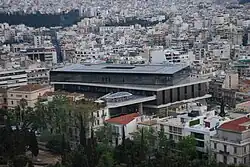 Acropolis Museum by Bernard Tschumi (2009)
 -
 Thessaloniki Concert Hall by Arata Isozaki (2010)
 -

See also
- Ancient Greek architecture
- Greek Revival architecture
- Modern architecture in Athens
- Mycenaean Revival architecture
References
- ^ Giacumacatos 2009, pp. 65–67.
External links
- Δημοσιογραφικός Οργανισμός Λαμπράκη. "Η αρχιτεκτονική του 20ού αιώνα στην Ελλάδα". Tovima.gr (in Greek). Retrieved 10 January 2018.

