Iranian handicrafts
| Part of a series on the |
| Culture of Iran |
|---|
 |
|
|
|
|
|
 Iran portal Iran portal |
Iranian handicrafts are handicraft or handmade crafted works originating from Iran.
Basketry and wickerwork
- Boryabaf, a bamboo wickerwork or textile, used to make floor mats, stools, and fans.
- Kapu (basket), a palm leaf basketry.[1]
- Tutan (boat), an indigenous boat made of tobacco leaves found in the Hamun Lake region[2]
Carpets and rugs
- Persian carpet
- Abadeh rug, type of carpet with a large diamond pattern
- Afshar rugs, carpets from the Turkic Afshar tribe
- Ardabil Carpet, the name of two different famous Safavid carpets which became a style[3]
- Dilmaghani, the oldest existing manufacturers of hand knotted carpets
- Gabbeh, a type of Persian nomadic carpet
- Heriz rug, type of carpet with copper in the wool and bold patterns with a large medallion
- Shiraz rug, a type of Persian carpet
- Tabriz rug, genre of carpets found in Tabriz
- Kilims, flat woven rug or tapestry[4]
- Zili, type of Kilim
- Soumak, flat woven rug, bedding, or tapestry; a stronger and thicker weave than a Kilim
-
 The Ardabil carpet
 -
 weaving a carpet in a caravansari in Meybod
 -
 gabbeh carpet
 -
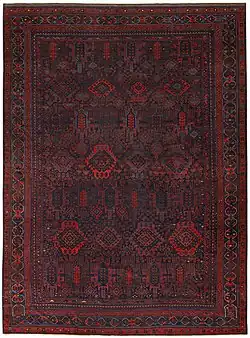 Baluch carpet, mid–19th century
 -
 Soumak rug
Textiles
- Persian embroidery
- Pateh, needlework on wool, with colored thread, mostly of silk. It is mostly created by women.[5]
- Rasht embroidery
- Sermeh embroidery
- Sistan embroidery and Sistan cream embroidery, using a black, cream or white thread color to decorate clothing or other fabrics
- Zardozi, metal embroidery thread work made of silver or gold.[6]
- Balochi needlework
- Brocade, shuttle-woven fabrics often made in colored silks and sometimes with gold and silver threads.
- Felt, a traditional weaving, common to the Kermanshah province[7]
- Ghelimche, a traditional machine woven fabric
- Ghalamkar, wood-block printed fabric, often used for table cloths or as bedspreads.[8]
- Khameh, silk embroidered on raw-colored fabric, typically in all white.[9]
- Jajim, hand-woven, colorful fabric often found in rural areas
- Termeh, hand woven fabric, often used for table cloths, or made into shawls.[10]
-
_Embroidery_Cushion_Covers.jpg) Up-close of Zardozi metal embroidery
Up-close of Zardozi metal embroidery -
 A sample of Termeh
 -
 Iranian Baluchi embroidery
 -
 Persian silk brocade fabric with silver thread (Persian: Golabetoon)
 -
 Bakhtiari felting in Shahr-e Kord
 -
 Pateh, needlework on wool
Metalwork
- Dovatgari[11][12]
- Enamelwork (Persian: Minakari)[13]
- Metal engraving (Persian: Ghalam-Zani), also toreutics, and repoussé and chasing[13][14]
- Openwork, a popular style for bronze work
- Silver-gilt
- Varshosazi, art of making products from nickel silver
-
 Tabriz-style copper
 -
 Persian metal engraving (golden plated), depicting Shah Anushirvan
 -
 ring making in Qom province
 -
 Openwork metal, incense burner, c. 11th century
 -
 Enamelwork
 -
 Store selling metalwork
Woodwork
- Girih, a branch of traditional architecture and tiling strapwork, often made of wood, but sometimes made of other materials.
- Moarragh (also known as Moarraq), traditional marquetry or wood inlay
- Khatam, marquetry using very small pieces, often made into boxes or to decorate home goods[15][13]
- Wood carving
-
 Girih screen found in Nishapur
 -
 A sample of Khatam box
 -
 Khatam items
 -
 Backgammon (Nard) board made in Khatam technique.
Pottery and ceramics
- Earthenware
- Fritware
- Garrus ware
- Gombroon ware
- Kraak ware
- Kubachi ware
- Lustreware
- Mina'i ware
- Moarragh, traditional ceramic mosaic tile developed by the Seljuks[16][17]
-
%252C_piatto_con_uccello_tra_fiori%252C_1580-1630_ca..JPG) Persian Kraak ware
Persian Kraak ware -
 glazed ceramic tile work, from the ceiling of the Tomb of Hafez in Shiraz
 -
_-_XVII_i%C3%A8me_si%C3%A8cle_-_Inventaire_AR_2005-22_(cropped).JPG) Kubachi ware
Kubachi ware -

-
 Mina'i ware
Stone, mosaic, and masonry
- Chiq, a building material used inside the walls of nomadic black tents called "siah chador".[18]
- Hardstone carving
- Sculpturing
- Stained glass (Orosi windows, or transliterated as Arasi, and Orsi)
- Firoozeh Koobi, made of a copper vessel that is covered with inlayed turquoise stone.[19]
- Stone inlay, the most popular stone used is carnelian, followed by turquoise to make traditional jewelry.[20] The inlay is typically laid in mastic and wax, then fixed with enamel and/or niello.[20]
-
.png) Firoozeh koobi or Persian turquoise inlay
Firoozeh koobi or Persian turquoise inlay -
 Colossal Statue of Shapur I, example of traditional statuary stone carving
 -
Enameled vase
-

Painting, drawing, and motifs
- Persian miniature
- Motifs
- Buta (ornament), a motif style
- Gol o Bolbol, a flower-and-bird motif style
- Paisley (design), a motif style
- Master of Animals
- Lion and Sun
- Illuminated manuscript
- Tashir (craft), a gilding and painting technique[21]
-
 example of a Persian miniature, "The Nightmare of Zahhak" (c. 1525–1535)
 -
.jpg) example of Tashir
example of Tashir -
 Gol o bolbol motif on earthenware tiles, from the Qajar-era
 -
 Persian silk brocade with silver and gold thread, with paisley pattern
Places in Iran to find handicrafts
- Grand Bazaar, Tehran
- Vakil Bazaar, Shiraz
- Bazaar-e Bozorg, Isfahan
- Tabriz Grand Bazaar, Tabriz
- Fire Temple of Yazd
See also
- Arts of Iran
- Persian art
- Persian-Sassanid art patterns
References
- ^ "Kapu of Khuzestan". www.visitiran.ir. Retrieved 2022-03-11.
- ^ "توتن (قایق) یکی از صنایع دستی سیستان /دریاچه هامون چشم انتظار حیات دوباره آن است". Young Journalist Club (in Persian). Retrieved 2022-03-11.
- ^ Beattie, M. (December 15, 1986). "Ardabīl Carpet". Encyclopaedia Iranica. Encyclopaedia Iranica Foundation. Retrieved 2022-03-11.
- ^ "پاسداري از ميراث و گنجينه گرانبهاي صنايع دستي در منابع مكتوب | ایبنا" [Protecting the heritage and precious treasures of handicrafts in written sources]. خبرگزاری کتاب ايران (IBNA) (in Persian). 2010-06-10. Retrieved 2022-03-11.
- ^ "Best Handicrafts of Iran: Souvenirs from the Past - Visit Our Iran - Discover Iran".
- ^ Johnston, Amanda; Hallett, Clive (2014-02-03). Fabric for Fashion: The Complete Guide: Natural and Man-made Fibres. Quercus Publishing. p. 515. ISBN 978-1-78067-513-8.
- ^ "نمدمالی کرمانشاهی، میراث معنوی ایرانی شد" [Kermanshahi felt became the spiritual heritage of Iran]. ایسنا (ISNA) (in Persian). 2013-01-31. Retrieved 2022-03-11.
- ^ Sarshar, Houman M. (2014-09-17). The Jews of Iran: The History, Religion and Culture of a Community in the Islamic World. Bloomsbury Publishing. pp. 214–215. ISBN 978-0-85773-710-6.
- ^ "Iranian handicrafts: Khameh-Duzi of Sistan-Baluchestan". Tehran Times. 2021-10-09. Retrieved 2022-10-07.
- ^ Middle East and Indian Ocean. Société d'histoire de l'Orient. 1999. p. 348. ISBN 978-2-7384-8380-5.
- ^ "A research on Shiraz's native art-industry condemned to oblivion". Allameh Tabataba’i University. 2023-09-09. Retrieved 2023-09-09.
Dovatgari
- ^ سامانیان, ساسان; بهمنی, ساره (2022-03-21). "پژوهشی در دواتگری شیراز هنر-صنعت بومی محکوم به فراموشی". دو فصلنامه دانش های بومی ایران (in Persian). 9 (17): 149–176. doi:10.22054/qjik.2023.71081.1343. ISSN 2345-6019.
- ^ a b c "Iranian handicraft; a rainbow of diversity rooted in old history". IRNA English. 2019-06-10. Retrieved 2022-03-11.
- ^ The Cambridge History of Iran by I. Gershevitch (1985) p.154
- ^ Meals, Roy A. (2020-10-20). Bones: Inside and Out. W. W. Norton & Company. p. 296. ISBN 978-1-324-00533-9.
- ^ Journal of the Australasian Ceramic Society. Australasian Ceramic Society. 1989. p. 54.
- ^ Crabtree, Pam J. (2008). Encyclopedia of Society and Culture in the Medieval World. Facts On File. p. 77. ISBN 978-0-8160-6936-1.
- ^ Gh, Akbar (2017-11-25). "Siāh chādor (lett: black tent) is a type of curtain made from the goat hairs". Iran Cultura. Retrieved 2022-03-11.
- ^ "Iranian MPs Authorize Formation of Handicraft Development Fund - Society/Culture news". Tasnim News Agency. July 5, 2017. Retrieved 2022-03-15.
- ^ a b Diba, Layla S. (2011). Turkmen Jewelry: Silver Ornaments from the Marshall and Marilyn R. Wolf Collection. Metropolitan Museum of Art. Metropolitan Museum of Art. ISBN 978-1-58839-415-6.
- ^ "آشنایی با هنر تشعیر". همشهری آنلاین (in Persian). 2011-07-13. Retrieved 2022-03-11.
External links

Wikimedia Commons has media related to Handicrafts of Iran.