Rosette (zoology)

A rosette is a rose-like marking or formation found on the fur and skin of some animals, particularly cats.[1][2]
Functions of coat patterns
The main function of coat patterns in cats is thought to be camouflage, as their primary hunting strategies involve stalking,[3] and hunts are typically more successful if initiated from a shorter distance.[4] There are many different types of camouflage, but they all aid in hiding the animal from others.
For example, the white pelage with smoky grey and black rosette patterns of the Panthera uncia (snow leopard) make it well adapted to life in cold climates with bare rocks and patchy snow. The rosette patterns in Panthera pardus (leopard) and Panthera onca (jaguar, pictured) likely reflect their habitation of wooded or forested ecosystems, which create dappled light environments where their high contrast markings obscure their body outline during ambush hunting.[5]
Formation
Coloration and patterning in mammals is most strongly influenced by an intricate process surrounding the regulation, migration, and differentiation of melanocytes, which are responsible for producing pigment in the skin and fur.[6] The type of pigment produced by the melanocyte is mainly determined by interactions between the Agouti signaling protein (ASIP) and α-melanocyte stimulating hormone (MSH) with the melanocortin-1 receptor (MC1R).[7]
Species in the family Panthera have highly diverse coat patterns. This is a result of their ancestors diverging around 10 million years ago in the late miocene.[8] They migrated to different locations on earth, which caused them to encounter new environments and new ecological pressures. As a result, they all faced different selective pressures, which caused certain evolved traits to be more advantageous than others. For the snow leopard, blending in with the snow caused them to develop a lighter coloration, as it is more advantageous. Whereas in the more shaded forests and jungles where leopards and jaguars live, darker rosettes help them blend in with the shadows.[9]
_male_walking_on_the_road_..._(50148578263).jpg)
_Zoo_Salzburg_2014_h_(cropped).jpg)
Leopard
The leopard (Panthera pardus) has a wide variety of coat coloration. On each color variation, the leopard has rosette patterns on their backs, flanks, and limbs. They also have patterns that are considered to be spots and not rosettes on their heads, stomach, and limbs.[10]
Jaguar
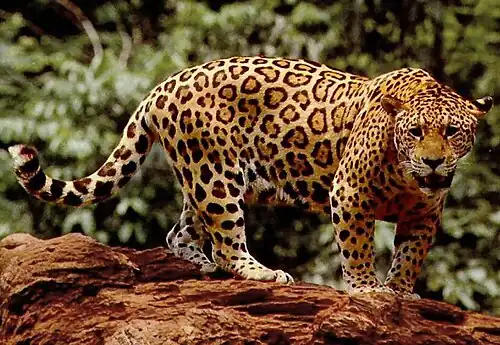
Like the leopard, the jaguar (Panthera onca) has a wide variety of coat coloration. The jaguar can have a coat in colors ranging from white to black with the most common residing in brownish yellow area. These big cats have rosettes on their bodies in random combination and pattern.[11]
Lion (cub)
.jpg)
Young lion (Panthera leo) cubs have rosette patterns on their legs and abdomen regions. These rosettes usually do not transfer into adulthood and fade as the cub ages. However, some mature lions may keep traces of their rosette patterns throughout life.[12] For the lion cub, the rosette markings act as camouflage in long grasses and bushes.[13]
Bengal Cat

The bengal cat (Felis catus x Prionailurus bengalensis) is a descendant from a combination of domestic cats and leopard cat lineage. This domesticated cat has a distinct coat pattern with a combination of rosettes, spots, and stripes.[14]
Cheetah
_female_after_chase.jpg)
While individual cheetahs (Acinonyx jubatus) do have distinct and identifiable coat patterns like leopards or jaguars, the cheetah's patterns are considered to be spots, not rosettes.[15]
Ocelot
.jpg)
Ocelots (Leopardus pardalis) have a coat pattern that may look like rosettes, however is considered to be a combination of spots and stripes.[16]
List of felids with rosettes
- Cheetah – the king cheetah variety has rosettes
- Bengal cat[17]
- Jaguar[2]
- Leopard – smaller, denser rosettes than the jaguar, lacking central spots[18][19]
- Leopard cat
- Liger
- Liliger
- Lion – cubs have rosettes, which may be retained on the legs in adults
- Litigon
- Margay
- Ocelot
- Safari cat
- Snow leopard
- Tigon
See also
- Leopard pattern
- Stripe (pattern)
References
- ^ Schneider, Alexsandra (2012). "How the Leopard Hides Its Spots: ASIP Mutations and Melanism in Wild Cats". PLOS ONE. 7 (12) e50386. PLOS. Bibcode:2012PLoSO...750386S. doi:10.1371/journal.pone.0050386. PMC 3520955. PMID 23251368.
- ^ a b John Hampden Porter (1894). Wild beasts; a study of the characters and habits of the elephant, lion, leopard, panther, jaguar, tiger, puma, wolf, and grizzly bear. New York, C. Scribner's sons. p. 239.
- ^ Allen, William L.; Cuthill, Innes C.; Scott-Samuel, Nicholas E.; Baddeley, Roland (2011-05-07). "Why the leopard got its spots: relating pattern development to ecology in felids". Proceedings of the Royal Society B: Biological Sciences. 278 (1710): 1373–1380. Bibcode:2011PBioS.278.1373A. doi:10.1098/rspb.2010.1734. ISSN 0962-8452. PMC 3061134. PMID 20961899.
- ^ Elliott, John P.; Cowan, I. McTaggart; Holling, C. S. (November 1977). "Prey capture by the African lion". Canadian Journal of Zoology. 55 (11): 1811–1828. Bibcode:1977CaJZ...55.1811E. doi:10.1139/z77-235. ISSN 0008-4301.
- ^ Allen, William L.; Cuthill, Innes C.; Scott-Samuel, Nicholas E.; Baddeley, Roland (2011-05-07). "Why the leopard got its spots: relating pattern development to ecology in felids". Proceedings of the Royal Society B: Biological Sciences. 278 (1710): 1373–1380. Bibcode:2011PBioS.278.1373A. doi:10.1098/rspb.2010.1734. ISSN 0962-8452. PMC 3061134. PMID 20961899.
- ^ Caro, Tim; Mallarino, Ricardo (April 2020). "Coloration in Mammals". Trends in Ecology & Evolution. 35 (4): 357–366. Bibcode:2020TEcoE..35..357C. doi:10.1016/j.tree.2019.12.008. PMC 10754262. PMID 31980234.
- ^ Barsh, Gregory S. (August 1996). "The genetics of pigmentation: from fancy genes to complex traits". Trends in Genetics. 12 (8): 299–305. doi:10.1016/0168-9525(96)10031-7. PMID 8783939.
- ^ Johnson, Warren E.; O'Brien, Stephen J. (January 1997). "Phylogenetic reconstruction of the felidae using 16S rRNA and NADH-5 mitochondrial genes". Journal of Molecular Evolution. 44 (S1): S98–S116. Bibcode:1997JMolE..44S..98J. doi:10.1007/PL00000060. ISSN 0022-2844. PMID 9071018.
- ^ Ortolani, Alessia; Caro, T. M. (2019-05-15), Gittleman, John L. (ed.), "4. The Adaptive Significance of Color Patterns in Carnivores: Phylogenetic Tests of Classic Hypotheses", Carnivore Behavior, Ecology, and Evolution, Cornell University Press, pp. 132–188, doi:10.7591/9781501745829-009, ISBN 978-1-5017-4582-9, retrieved 2026-03-09
{{citation}}: CS1 maint: work parameter with ISBN (link) - ^ Macdonald, D.W., ed. (2009). "The Princeton encyclopedia of mammals: Leopard". Windmill Books (Andromeda International). Retrieved 2022-10-10.
- ^ Macdonald, D.W., ed. (2009). "The Princeton encyclopedia of mammals: Other big cats". Windmill Books (Andromeda International. Retrieved 2022-10-25.
- ^ Macdonald, D.W. (ed.). "The Princeton encyclopedia of mammals: Lion". Windmill Books (Andromeda International). Retrieved 2022-10-10.
- ^ "Let's look at Lions - Learn about the African Lion". ALERT. Retrieved 2022-11-21.
- ^ Butler, S., ed. (2017). "Macquarie Dictionary: Bengal Cat" (7th ed.). Macquarie Dictionary Publishers. Retrieved 2022-10-10.
- ^ Macdonald, D.W., ed. (2009). "The Princeton encyclopedia of mammals: Cheetah". Windmill Books (Andromeda International). Retrieved 2022-10-10.
- ^ "Británica concise encyclopedia: ocelot". Británica Digital Learning. 2017. Retrieved 2022-10-10.
- ^ "Cat Colours and Patterns - Plain English Version". messybeast.com. Retrieved 2023-04-30.
- ^ Naish, D. "The Pogeyan, a new mystery cat". ScienceBlogs.com. Retrieved 2009-01-19.
- ^ Searle, A. G. (1968). Comparative Genetics of Coat Colour in Mammals. Logos Press, London.