Shyok River
| Shyok River | |
|---|---|
 The Shyok River near Khaplu, Gilgit-Baltistan, Pakistan | |
 Course of the Shyok River | |
| Location | |
| Countries | India, Pakistan |
| Territories | Ladakh, Gilgit-Baltistan |
| Physical characteristics | |
| Source | Rimo Glacier |
| • location | Ladakh, India |
| • coordinates | 35°21′10″N 77°37′05″E / 35.3527°N 77.6180°E |
| • elevation | 5,000 m (16,000 ft) |
| Mouth | Indus River |
• location | Gilgit-Baltistan, Pakistan |
• coordinates | 35°13′43″N 75°55′02″E / 35.2286°N 75.9172°E |
• elevation | 2,314 m (7,592 ft) |
| Length | 550 km (340 mi) |
| Basin size | 33,465 km2 (12,921 sq mi) |
| Discharge | |
| • location | Yugo gauging station, Gilgit-Baltistan, Pakistan |
| • average | 390 m3/s (14,000 cu ft/s) |
| • minimum | 180 m3/s (6,400 cu ft/s) |
| • maximum | 546 m3/s (19,300 cu ft/s) |
| Basin features | |
| Progression | Indus→ Arabian Sea |
| River system | Indus Basin |
| Tributaries | |
| • left | Chip Chap River, Galwan River, Chang Chenmo River |
| • right | Nubra River, Hushe River |
The Shyok River (sometimes spelled Shayok) is a major tributary of the Indus River that flows through northern Ladakh in India and into Gilgit-Baltistan in Pakistan. Originating from the Rimo Glacier in the eastern Karakoram, it runs for about 550 km (340 mi) before joining the Indus near Skardu. Its basin, covering 33,465 km2 (12,921 sq mi), extends across three countries: India, Pakistan, and China. Its major tributaries include the Chip Chap, Galwan, Chang Chenmo, Nubra, and Hushe rivers.
Name and etymology
At least three hypotheses have been formulated regarding the origin of the river's name, Shyok, also spelled Shayok.
In 1854, Alexander Cunningham mentioned that the river took its name from the village of Shyok, which he spelled Shayok, located along its course,[1] but he did not substantiate this statement or provide etymological information about the village’s name.
In 1977, Friedrich A. Peter observed that Shyok was a misspelling of the Tibetan name Shayog (Tibetan: ཤ་གཡོག་, Wylie: sha-gyog). And he identified the name Shayog as being formed by the syllables shag (Tibetan: ཤག་, ‘gravel’) and gyog (Tibetan: གཡོག་, ‘to spread’) and meaning ‘gravel spreader’, alluding to the vast quantities of gravel deposited by the river floods.[2]
In 1992, Harish Kapadia argued that many geographical names along the historic trade route in the upper Shyok valley were of Yarkandi origin, the Turkic dialect spoken by travellers from Yarkand in Central Asia. He interpreted Shyok as meaning ‘river of death’, from the Yarkandi sheo (‘death’), and related this interpretation to the river's deadly floods.[3]
Course
The Shyok rises from the Rimo Glacier in the eastern Karakoram,[4] with its source located in Ladakh, India,[5]: 124–125 and flows for approximately 550 km (340 mi) through Ladakh and then Gilgit-Baltistan, Pakistan, where it joins the Indus River.[6] Its general course is south-southeastward at first,[7] then it makes a major V-shaped bend,[5]: 124–125 and continues west-northwestward.[1]
The river originates at the snout of the Rimo Glacier in the Rimo Muztagh, a subrange of the eastern Karakoram.[4][8] Its source is located west of the Depsang Plains,[5]: 124–125 [7] at approximately 35°21′10″N 77°37′05″E / 35.3527°N 77.6180°E and 5,000 m (16,000 ft) elevation,[9] in northern Ladakh, India.[5]: 124–125 Near its source, it is joined by the Chip Chap River, which can be regarded as part of its headwaters.[5]: 124–125 [8]

From the Chip Chap confluence to its major bend, the river flows generally south-southeastward,[7] between the Rimo Muztagh and Saser Muztagh ranges to the west and Aksai Chin to the east.[7][8][10] About midway along this reach, it receives the Galwan River,[5]: 124–125 [10] and a little upstream of the bend, it is joined by the Chang Chenmo River.[4][10] At the Chang Chenmo Range, it forms a major V-shaped bend, reversing its direction to the northwest, a distinctive feature.[5]: 124–125 [7]
After the bend, and as it approaches the confluence with the Nubra River, the valley widens and the river becomes braided.[1][11] It receives the Nubra near the village of Diskit.[7][11]

From the Nubra confluence to that with the Hushe River, the river flows generally west-northwestward,[1][7] between the Saltoro Range to the north and the Ladakh Range to the south.[11] Some distance downstream of the Nubra confluence, the valley narrows and, near the hamlet of Yagulung (also known as Changmar), turns into a gorge.[1][11] Farther downstream, the river crosses from Ladakh, India, into Gilgit-Baltistan, Pakistan.[6] The valley widens and the river becomes braided again shortly before the Hushe confluence.[12] Near the town of Khaplu, it is joined by the Hushe.[5]: 124–125 [12]
From the Hushe confluence to its mouth, where it joins the Indus, the river flows generally westward, between the Masherbrum Range to the north and the Ladakh Range to the south.[12] The mouth is located near the village of Keris,[1][12] at approximately 35°13′43″N 75°55′02″E / 35.2286°N 75.9172°E and 2,314 m (7,592 ft) elevation,[9] in eastern Gilgit-Baltistan, Pakistan.[6]
Tributaries

Upstream of its major V-shaped bend, the Shyok has three main tributaries that originate in Aksai Chin and flow into its left bank generally from the east:[7]
- The Chip Chap River rises at the eastern edge of the Depsang Plains, flows around them to the north in a generally westward direction, and joins the Shyok near its source, from the northeast.[5]: 56–57 [13][8]
- The Galwan River originates in western Aksai Chin, flows generally westward, and merges with the Shyok roughly halfway between its source and its major bend, from the east.[5]: 63 [10]
- The Chang Chenmo River rises near Lanak La pass in Aksai Chin, flows north of the Chang Chenmo Range in a westward direction, and enters the Shyok a little upstream of its major bend, from the east.[5]: 53 [14][10]
Downstream of the major bend, the Shyok has two main tributaries that originate in the eastern and central Karakoram and flow into its right bank generally from the north:[7]
- The Nubra River comes from the Siachen Glacier in the eastern Karakoram and flows south-southeastward between the Saltoro Range to the west and the Rimo Muztagh and Saser Muztagh ranges to the east. It joins the Shyok near the village of Diskit, from the north-northwest.[15][16][5]: 106 [8][11]

- The Hushe River originates from the Gondogoro Glacier in the central Karakoram, flows generally southward, and enters the Shyok near the town of Khaplu, having been joined shortly before by the Saltoro River.[5]: 74 [12]
Basin and hydrology
The Shyok basin primarily drains part of the southern slopes of the central Karakoram, the southern slopes of the eastern Karakoram, part of Aksai Chin, and part of the northern slopes of the Ladakh Range.[17]: 32 [18] It covers approximately 33,465 km2 (12,921 sq mi), distributed across India (54%), Pakistan (28%) and China (18%).[19]
The Shyok is fed approximately 49% by glacier melt, 39% by snowmelt and 12% by rainfall.[19] Its discharge and sediment transport regime is predominantly glacial and nival, with a peak in summer, during the melt season, and a trough in winter.[20] Over the period 1981–2010, its mean discharge at the Yugo gauging station, near where it joins the Indus River, was 390 m3/s (14,000 cu ft/s), with a minimum of 180 m3/s (6,400 cu ft/s) and a maximum of 546 m3/s (19,300 cu ft/s).[21] Over the same period and at the same station, the suspended sediment concentration showed notable seasonal and interannual variability, ranging from 129 mg/L to 5,220 mg/L.[21]
Geology
The Shyok flows through the collision zone between the Indian and Eurasian plates, a collision that led to the formation of the Himalayas and Karakoram. Its middle course runs along the suture zone between the Ladakh block to the south and the Karakoram block to the north, known as the Shyok Suture Zone.[22][23] The region is also crossed by the Karakoram fault, a major northwest–southeast-trending strike-slip fault that accommodates part of the India–Eurasia post-collision deformation.[24][25][26]
During the Cretaceous (about 143–66 million years ago), the oceanic crust of the Neo-Tethys Ocean, an ancient ocean that separated the Indian and Eurasian plates, subducted beneath Eurasia.[27][28][29] This subduction generated the Kohistan–Ladakh volcanic arc.[27][28] In the Late Cretaceous (about 101–66 million years ago) or Palaeocene (about 66–56 million years ago), the arc and the Karakoram block, on the southern margin of Asia, collided and the intervening basin closed.[24][30] The Shyok Suture Zone is the scar left by this closure.[31][32] Since the Miocene (about 23–5 million years ago), part of the deformation resulting from the subsequent India–Eurasia collision has been accommodated by large faults, particularly the Karakoram fault.[33][34]
The Ladakh block is dominated by the Ladakh batholith, a large body of igneous rock formed by the solidification of magma at depth and composed mainly of granodiorite and granite.[35][36][37] The Shyok Suture Zone contains what is called a tectonic mélange, that is, a chaotic mixture formed by tectonic deformation, composed of fragments of the ancient oceanic crust (ophiolites), volcanic rocks and deep-marine sediments.[32][22] The Karakoram block is dominated by metamorphic rocks, that is, rocks transformed by heat and pressure, particularly gneisses and schists.[32][35]
The morphology of the Shyok valley results from tectonic activity, Quaternary glaciation and fluvial erosion.[38][39][40] The river course is partly controlled by the Karakoram fault and the Shyok Suture Zone.[35][27] Glaciation has shaped large parts of its valley into a U-shape.[40][38] The large volumes of sediment supplied by glaciers often give the river a braided pattern,[38][40][30] while phases of incision have locally produced fluvial terraces.[38][23]
Valley
The Shyok flows through a rocky gorge carved into the Karakoram, with broad semiarid valleys in places that allow limited vegetation and agriculture.[6][41] The valley floor descends from 5,000 m (16,000 ft) at the snout of the Rimo Glacier to 2,314 m (7,592 ft) at the river’s confluence with the Indus at the village of Keris, near Skardu. In its lower reaches, seasonal meltwaters inundate the floodplain, supporting irrigated fruit orchards—apricots, walnuts, apples—and small villages.[6][42] During winter, the river often freezes solid, providing a natural passage between the Nubra Valley and Khaplu.[1][42]
History
During the 19th century, the Shyok and its valley became increasingly documented as part of British efforts to map the remote frontier regions of Ladakh and Baltistan.[43] Survey teams from the Survey of India—which conducted extensive frontier surveys following the Treaty of Amritsar (1846)—charted parts of the Shyok and its tributaries. These expeditions laid the groundwork for modern cartographic understanding of the western Himalaya and Karakoram ranges.[44]
The Shyok Valley also held historical significance as a segment of trade and travel routes connecting Leh with Baltistan and western Tibet. Caravans moving between Central Asia and the Indian subcontinent frequently navigated its upper reaches, making use of natural passes and riverine paths.[45][46][44][47] This strategic utility continued into the colonial period, when the British occasionally used these routes for communications and patrols along the mountain frontiers.

In the 20th and 21st centuries, the river has taken on renewed strategic importance due to its proximity to contested border zones—specifically near the Line of Actual Control (LAC) with China and the Line of Control (LoC) with Pakistan. Infrastructure such as the Darbuk–Shyok–Daulat Beg Oldi (DS–DBO) road has been built along the river’s banks, enhancing military logistics in the region adjacent to the Siachen Glacier and Aksai Chin.[48][49]
Tourism
The Shyok Valley provides access to the Nubra Valley, a popular destination in Ladakh. Key attractions along the Shyok include the sand dunes and Bactrian camel rides near the village of Hundar (also spelled Hunder), as well as the Diskit Monastery and its annual Diskit Gustor Festival.[50][51][52]
See also
- Geography of Ladakh
- Geography of Gilgit-Baltistan
- List of rivers of India
- List of rivers of Pakistan
- Daulat Beg Oldi
- Khardung La
- Ladakh Range
References
- ^ a b c d e f g Cunningham, Alexander (1854). Ladák: Physical, Statistical, and Historical; with Notices of the Surrounding Countries. London: W.H. Allen and Co. pp. 94–96.
- ^ Peter, Friedrich A. (1977). "Glossary of Place Names in Western Tibet". The Tibet Journal. 2 (2). Library of Tibetan Works and Archives: 26–27. JSTOR 43299854.
- ^ Kapadia, Harish (1992). "Lots in a Name". The Himalayan Journal. 48. Archived from the original on 18 August 2019. Retrieved 25 May 2025.
Shyok ('the river of death', Sheo: death)
- ^ a b c Kaul, Hriday Nath (1998). Rediscovery of Ladakh. Indus Publishing Company. pp. 30–31. ISBN 9788173870866.
- ^ a b c d e f g h i j k l m Negi, Sharad Singh (1991). Himalayan Rivers, Lakes, and Glaciers. Indus Publishing Company. ISBN 9788185182612.
- ^ a b c d e "Shyok River". Encyclopædia Britannica. Retrieved 23 May 2025.
- ^ a b c d e f g h i India and Adjacent Countries: Sheet 52 – Leh (Map) (Published 1923 ed.). 1:1,000,000. Survey of India. 1916. Retrieved 28 May 2025.
- ^ a b c d e Chulung (Map). 1:250,000. India and Pakistan 1:250,000. Army Map Service, Corps of Engineers, U.S. Army. 1955. Sheet NI 43-4. Retrieved 28 May 2025.
- ^ a b Google Earth imagery (Map). Google. Retrieved 24 November 2025.
- ^ a b c d e Shyok (Map). 1:250,000. India and Pakistan 1:250,000. Army Map Service, Corps of Engineers, U.S. Army. 1955. Sheet NI 44-5. Retrieved 28 May 2025.
- ^ a b c d e Leh (Map). 1:250,000. India and Pakistan 1:250,000. Army Map Service, Corps of Engineers, U.S. Army. 1955. Sheet NI 43-8. Retrieved 7 June 2025.
- ^ a b c d e Mundik (Map). 1:250,000. India and Pakistan 1:250,000. Army Map Service, Corps of Engineers, U.S. Army. 1955. Sheet NI 43-3. Retrieved 7 June 2025.
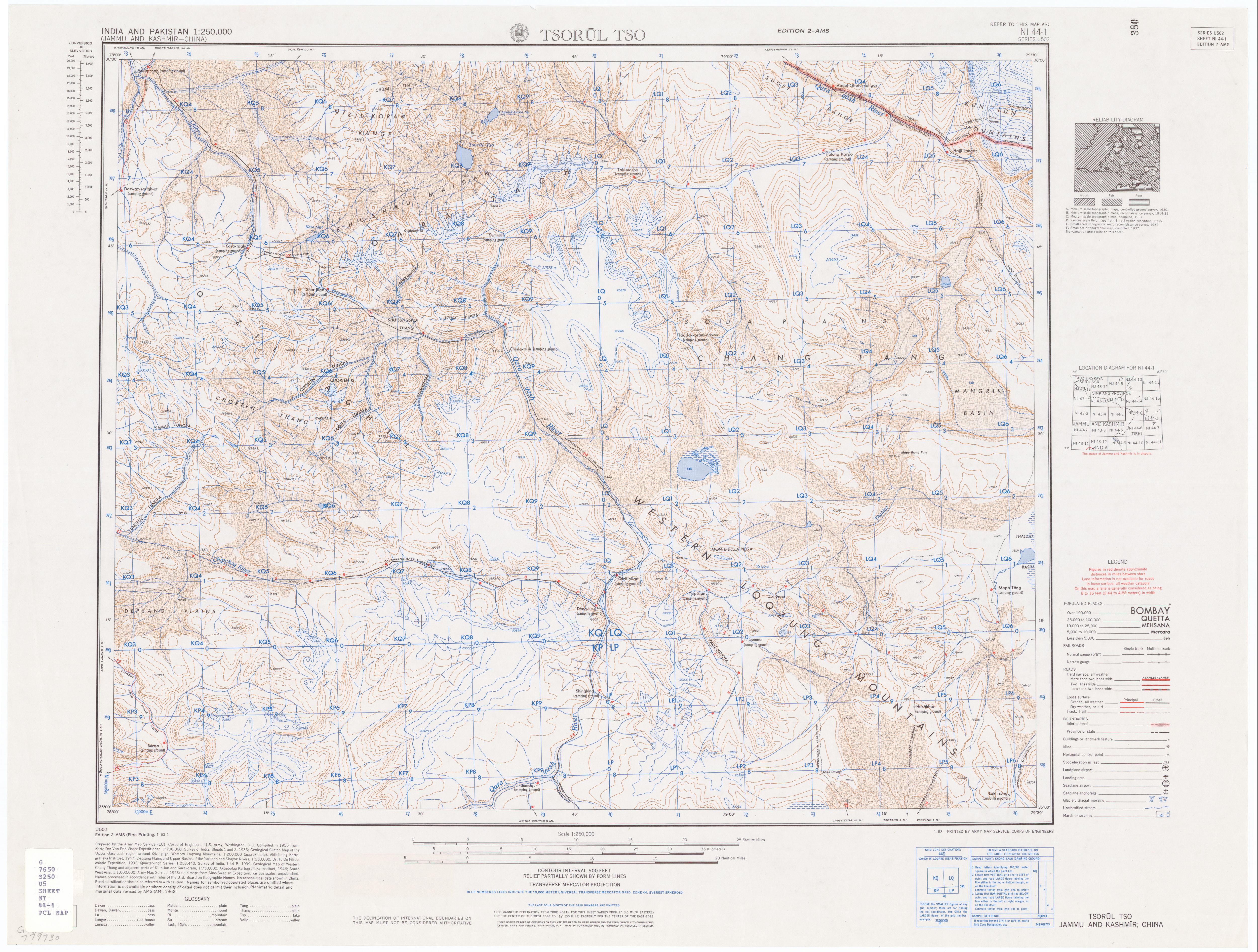
- ^ Tsorul Tso (Map). 1:250,000. India and Pakistan 1:250,000. Army Map Service, Corps of Engineers, U.S. Army. 1955. Sheet NI 44-1. Retrieved 23 January 2026.
- ^ Sharma, Raghav Sharan (6 December 2017). The Unfought War of 1962: An Appraisal. Taylor & Francis. p. 39. ISBN 9781351056366.
The tributary originates from Lanak la under Chinese possession.
- ^ "Siachen Glacier". Encyclopædia Britannica. Retrieved 23 January 2026.
- ^ Kale, Vishwas S. (23 May 2014). Landscapes and Landforms of India. Springer. p. 106. ISBN 9789401780292.
- ^ Rizvi, Janet (1998). Ladakh : crossroads of high Asia. New Delhi: Oxford University Press. ISBN 9780195645460.
- ^ Ahmad, I.; Ahmad, Z.; Munir, S.; Rehman, Obaid Ur; Ali, S. R.; Shabbir, Y. (13 April 2018). "Characterization of Upper Indus Basin based on DEM Hypsometric Analysis". The Nucleus. 55 (1): 8–16. doi:10.71330/thenucleus.2018.315. Retrieved 9 February 2026.
- ^ a b Farooq, Muhammad Umar; Kharal, Muhammad Ashiq; Bogacki, Wolfgang; Ismail, Muhammad Fraz; Mehmood, Asif (2023). "Estimation of component-wise runoff contribution using temperature index approach, in a snow- and glacier-fed transboundary Shyok River catchment of the Upper Indus Basin". Arabian Journal of Geosciences. 16 (8): 460. Bibcode:2023ArJG...16..460F. doi:10.1007/s12517-023-11583-y.
Shyok River is a transboundary stream that has a catchment area of 33,465 km2 over three countries; Pakistan 28%, India 54%, and China 18%.
- ^ Tarar, Zeeshan Riaz; Ahmad, Sajid Rashid; Ahmad, Iftikhar; Majid, Zahra (2018). "Detection of Sediment Trends Using Wavelet Transforms in the Upper Indus River". Water. 10 (7): 918. Bibcode:2018Water..10..918T. doi:10.3390/w10070918.
- ^ a b Ul Hussan, Waqas; Khurram Shahzad, Muhammad; Seidel, Frank; Costa, Anna; Nestmann, Franz (6 March 2020). "Comparative Assessment of Spatial Variability and Trends of Flows and Sediments under the Impact of Climate Change in the Upper Indus Basin". Water. 12 (3): 730. Bibcode:2020Water..12..730U. doi:10.3390/w12030730. ISSN 2073-4441.
- ^ a b Upadhyay, Rajeev (1997). "Tectonics and sedimentation in the passive margin, trench, fore-arc and backarc areas of the Indus Suture Zone in Ladakh and Karakorum: a review". Geodinamica Acta. 10 (1): 1–11. Bibcode:1997GeoAc..10....1S. doi:10.1080/09853111.1997.11105289.
- ^ a b Upadhyay, Rajeev Umar; Gautam, Saurabh; Awatar, Ram (2022). "Discovery of an Entrapped Early Permian (ca. 299 Ma) Peri-Gondwanic Sliver in the Cretaceous Shyok Suture of Northern Ladakh, India: Diverse Implications". GSA Today. 32 (1): 4–9. Bibcode:2022GSAT...32a...4U. doi:10.1130/GSATG481A.1.
- ^ a b Borneman, Nathaniel L.; Hodges, Kip V.; van Soest, Matthijs C.; Bohon, Wendy; Wartho, Jo-Anne; Cronk, Stephanie S.; Ahmad, Talat (2015). "Age and structure of the Shyok suture in the Ladakh region of northwestern India: Implications for slip on the Karakoram fault system". Tectonics. 34 (10): 2011–2033. Bibcode:2015Tecto..34.2011B. doi:10.1002/2015TC003933.
- ^ Rutter, E.H.; Faulkner, D.R.; Brodie, K.H.; Phillips, R.J.; Searle, M.P. (2007). "Rock deformation processes in the Karakoram fault zone, Eastern Karakoram, Ladakh, NW India". Journal of Structural Geology. 29 (8): 1315–1326. Bibcode:2007JSG....29.1315R. doi:10.1016/j.jsg.2007.05.001.
- ^ Mohanty, Aditya; Gahalaut, V.K.; Chowdhury, Sonalika; Bansal, Amit Kumar; Gautam, Param; Catherine, Joshi (2024). "Geodetic constraints on slip rate on the Karakoram fault and its role in the Himalayan arc deformation". Earth and Planetary Science Letters. 626 118512. Bibcode:2024E&PSL.62618512M. doi:10.1016/j.epsl.2023.118512.
- ^ a b c Kapp, Paul; DeCelles, Peter G. (2019). "Mesozoic–Cenozoic Geological Evolution of the Himalayan-Tibetan Orogen and Working Tectonic Hypotheses". American Journal of Science. 319 (3): 159–254. Bibcode:2019AmJS..319..159K. doi:10.2475/03.2019.01.
- ^ a b Martin, Craig R.; Jagoutz, Oliver; Upadhyay, Rajeev; Royden, Leigh H.; Eddy, Michael P.; Bailey, Elizabeth; Nichols, Claire I. O.; Weiss, Benjamin P. (2020). "Paleocene latitude of the Kohistan–Ladakh arc indicates multistage India–Eurasia collision". Proceedings of the National Academy of Sciences. 117 (47): 29487–29494. Bibcode:2020PNAS..11729487M. doi:10.1073/pnas.2009039117. PMC 7703637. PMID 33148806.
- ^ Jagoutz, Oliver; Royden, Leigh; Holt, Adam F.; Becker, Thorsten W. (2015). "Anomalously fast convergence of India and Eurasia caused by double subduction". Nature Geoscience. 8 (6): 475–478. Bibcode:2015NatGe...8..475J. doi:10.1038/ngeo2418.
- ^ a b Pundir, Shailendra; Adlakha, Vikas; Kumar, Santosh; Singhal, Saurabh (2020). "Closure of India–Asia Collision Margin along the Shyok Suture Zone in the Eastern Karakoram: New Geochemical and Zircon U–Pb Geochronological Observations". Geological Magazine. 157 (9): 1451–1472. Bibcode:2020GeoM..157.1451P. doi:10.1017/S0016756819001547.
- ^ Chandra, Rakesh; Kowser, Nazia; Brookfield, Michael E; Satyanarayanan, Manavalan; Stöckli, Daniel (2023). "Nature of the Shyok (Northern) Suture Zone between India and Asia: petrology, geochemistry and origin of the Tirit granitoids and associated dykes (Nubra Valley Ladakh Himalaya, NW India)". Geological Magazine. 160 (5): 1020–1039. Bibcode:2023GeoM..160.1020C. doi:10.1017/S0016756823000134.
- ^ a b c Robertson, Alastair H. F.; Collins, Alan S. (2002). "Shyok Suture Zone, N Pakistan: late Mesozoic Tertiary evolution of a critical suture separating the oceanic Ladakh Arc from the Asian continental margin". Journal of Asian Earth Sciences. 20 (3): 309–351. Bibcode:2002JAESc..20..309R. doi:10.1016/S1367-9120(01)00041-4.
- ^ Yin, An; Harrison, T. Mark (2000). "Geologic Evolution of the Himalayan-Tibetan Orogen". Annual Review of Earth and Planetary Sciences. 28: 211–280. Bibcode:2000AREPS..28..211Y. doi:10.1146/annurev.earth.28.1.211.
- ^ Searle, M. P.; Weinberg, Roberto; Dunlap, W. J. (1998). "Transpressional tectonics along the Karakoram fault zone, northern Ladakh: Constraints on Tibetan extrusion". Geological Society, London, Special Publications. 135 (1): 307–326. Bibcode:1998GSLSP.135..307S. doi:10.1144/GSL.SP.1998.135.01.20.
- ^ a b c Searle, M.; Windley, Brian; Coward, M.P.; Cooper, D.J.W.; Rex, A.J.; Rex, D.; Tingdong, Li; Xuchang, Xiao; Jan, M.; Thakur, V.C.; Kumar, S. (1987). "The closing of Tethys and the tectonics of the Himalaya". Geological Society of America Bulletin. 98 (6): 678–701. Bibcode:1987GSAB...98..678S. doi:10.1130/0016-7606(1987)98<678:TCOTAT>2.0.CO;2.
- ^ Weinberg, Roberto F.; Dunlap, W. J. (2000). "Growth and Deformation of the Ladakh Batholith, Northwest Himalayas: Implications for Timing of Continental Collision and Origin of Calc-Alkaline Batholiths". The Journal of Geology. 108 (3): 303–320. Bibcode:2000JG....108..303W. doi:10.1086/314405. PMID 10769158.
- ^ Bhat, Irfan Maqbool; Ahmad, Talat (2021). "Evolution of the Ladakh Magmatic Arc". Journal of Geological Society of India. 97 (9): 971–1112. Bibcode:2021JGSI...97..980B. doi:10.1007/s12594-021-1812-1.
- ^ a b c d Bhardwaj, Pranshu; Nagar, Y.C.; Singh, Tejpal; Shekhar, M.S.; Ganju, A. (2024). "Reconstruction of landscape change of Shyok valley, Ladakh during Late Quaternary using OSL technique". Quaternary International. 710: 1–17. Bibcode:2024QuInt.710....1B. doi:10.1016/j.quaint.2024.08.010.
- ^ Phillips, Richard J. (2008). "Geological map of the Karakoram fault zone, Eastern Karakoram, Ladakh, NW Himalaya". Journal of Maps. 4 (1): 21–37. Bibcode:2008JMaps...4...21P. doi:10.4113/jom.2008.98.
- ^ a b c Kumar, Santosh; Bora, Sita; Sharma, Umesh K.; Yi, Keewook; Kim, Namhoon (2017). "Early Cretaceous subvolcanic calc-alkaline granitoid magmatism in the Nubra-Shyok valley of the Shyok Suture Zone, Ladakh Himalaya, India: Evidence from geochemistry and U–Pb SHRIMP zircon geochronology". Lithos. 277: 33–50. Bibcode:2017Litho.277...33K. doi:10.1016/j.lithos.2016.11.019.
- ^ Paul, Abdul Qayoom; Bahuguna, Harish; Kumar, Parveen (2024). "A glaciotectonic landform in the Shyok valley, Trans-Himalayan Karakoram Range, India". Journal of Glaciology. 70 (e44) e44. Bibcode:2024JGlac..70E..44P. doi:10.1017/jog.2024.22.
- ^ a b "Shyok Valley Ladakh". Ladakh Travel Mart. 22 October 2022. Retrieved 8 June 2025.
- ^ Dutta, Sutapa; Mukherjee, Nilanjana (2019). Mapping India, Transitions and Transformations, 18th–19th Century. Taylor & Francis. ISBN 9781000186406.
- ^ a b Gazetteer of Kashmir and Ladak. Superintendent of Government Printing, Calcutta. 1890. pp. 749–750.
- ^ Warikoo, Kulbhushan (2009). "India's Gateway to Central Asia: Trans-Himalayan Trade and Cultural Movements Through Kashmir and Ladakh, 1846–1947". In Kulbhushan Warikoo (ed.). Himalayan Frontiers of India: Historical, Geo-Political and Strategic Perspectives. Routledge. ISBN 9780415468398.
Those traders and passersby who opted to travel to Yarkand in winter would cross Digar La and follow the narrow and winding valleys of the Shyok river. This river, which was frozen during winter, was to be crossed and re-crossed several times.
- ^ Trotter, Henry (1878). "On the Geographical Results of the Mission to Kashghar, under Sir T. Douglas Forsyth in 1873–74". Journal of the Royal Geographical Society of London. 48. Royal Geographical Society: 173–234. doi:10.2307/1798763. JSTOR 1798763.
- ^ Hayward, George W. (1870). "Journey from Leh to Yarkand and Kashgar, and Exploration of the Sources of the Yarkand River". Journal of the Royal Geographical Society of London. 40: 33–166. doi:10.2307/1798640. ISSN 0266-6235. JSTOR 1798640.
- ^ Subramanian, Nirupama (11 June 2020). "Explained: The strategic road to DBO". The Indian Express. Archived from the original on 11 June 2020. Retrieved 10 June 2025.
- ^ Banerjee, Ajay (22 April 2019). "India completes vital Ladakh road". The Tribune (India). Archived from the original on 9 June 2020. Retrieved 10 June 2025.
- ^ "Tourism - The Administration of Union Territory of Ladakh - India". Administration of Union Territory of Ladakh. Retrieved 12 June 2025.
- ^ "Shyok Valley". Leh Ladakh Tourism. Retrieved 12 June 2025.
- ^ "Shyok Valley". Leh Ladakh Kashmir Travels. Retrieved 12 June 2025.
Further reading
- Hedin, Sven Anders (1916). Southern Tibet: Discoveries in Former Times Compared with My Own Researches in 1906–1908. Vol. 7. Lithographic Institute of the General Staff of the Swedish Army.
- Kapadia, Harish (1999). Across Peaks & Passes in Ladakh, Zanskar & East Karakoram. Indus Publishing Company. ISBN 9788173871009.
External links

- Index of U.S. Army Map Service topographic maps of India (1955) – includes sheets covering the Shyok River region
- On Death Trail – Shyok, a travelogue and exploration account by Harish Kapadia
- Photo galleries of the Shyok and Nubra Valleys (in German)
| State symbols | |||||||||||||||||||
|---|---|---|---|---|---|---|---|---|---|---|---|---|---|---|---|---|---|---|---|
| History |
| ||||||||||||||||||
| Administration |
| ||||||||||||||||||
| Geography |
| ||||||||||||||||||
| Human settlements | |||||||||||||||||||
| Culture |
| ||||||||||||||||||
| Tourism and wildlife |
| ||||||||||||||||||
| Transport |
| ||||||||||||||||||
| Infrastructure |
| ||||||||||||||||||
| See also |
| ||||||||||||||||||