Tachypleus gigas
| Tachypleus gigas | |
|---|---|
| |
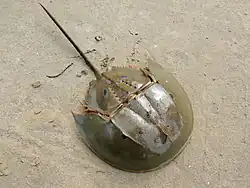
| Female, off the Bay of Bengal | |
Scientific classification 
| |
| Kingdom: | Animalia |
| Phylum: | Arthropoda |
| Subphylum: | Chelicerata |
| Order: | Xiphosura |
| Family: | Limulidae |
| Genus: | Tachypleus |
| Species: | T. gigas
|
| Binomial name | |
| Tachypleus gigas (Müller, 1785)
| |
| Synonyms[2] | |
| |

Tachypleus gigas, commonly known as the Indo-Pacific horseshoe crab,[3] Indonesian horseshoe crab,[4] Indian horseshoe crab,[5] or southern horseshoe crab,[6] is one of the four extant (living) species of horseshoe crab. It is found in coastal water in South and Southeast Asia at depths to 40 m (130 ft).[2]
Description

It grows up to about 50 cm (20 in) long, including the tail, and is covered by a sturdy carapace that is up to about 26.5 cm (10.4 in) wide.[7]
Tachypleus gigas has a sage-green chitinous exoskeleton.[8] Like other horseshoe crabs, the carapace of T. gigas consists of a larger frontal one (the prosoma) and a smaller, spine-edged rear one (the opisthosoma).[9][10] There are six pairs of prosomal appendages/legs, consisting of a small frontal pair in front of the mouth and five larger walking/pushing legs on either side of the mouth.[9] The book gills are located on the underside of the opisthosoma.[9][11] They have a long spiny tail known as the telson. The tail bears a crest dorsally and is concave ventrally,[2] giving it an essentially triangular cross section.[9]
Despite the scientific name T. gigas, the close relative Tachypleus tridentatus reaches a larger size. Both are considerably larger than Carcinoscorpius rotundicauda.[12] The carapace which shields the prosoma also bears two pairs of eyes – a pair of simple eyes at the front, and a pair of compound eyes positioned laterally. In common with other horseshoe crabs, T. gigas also has ventral eyes near the mouthparts, and photoreceptors in the caudal spine.[13]
Sexual difference
Like the other species, females of T. gigas grow larger than males. On average in Sarawak, Malaysia, females are about 42 cm (17 in) long, including a tail that is about 20 cm (7.9 in), and their carapace (prosoma) is about 22 cm (8.7 in) wide. In comparison, the average for males is about 34 cm (13 in) long, including a tail that is about 17.5 cm (6.9 in), and their carapace is about 17.5 cm (6.9 in) wide.[7] There are some geographic variations in the average size, but most are similar to, or somewhat smaller, than the ones from Sarawak. An outlier are individuals from West Bengal in India where the average carapace width only is about 17 cm (6.7 in) and 14 cm (5.5 in) in females and males respectively.[9] The largest females of the species reach a total length of more than 50 cm (20 in) and can weigh more than 1.8 kg (4.0 lb).[7]
In addition to their smaller size, males have a paler and rougher carapace, act as hosts to a greater number of epibionts,[8] have six (instead of three) long spines on either side of the rear carapace, and their two front pairs of walking legs, prosomal appendages two and three, have hooks (they are scissor-like in females).[6] Juveniles (both sexes) also have six long spines on either side of the rear carapace, similar to adult males.[6]
Distribution and habitat
_found_dead_on_the_boardwalk_-_Lintang_Trail%252C_Bako_NP%252C_Sarawak%252C_Malaysia.jpg)

Tachypleus gigas is one of three living species of horseshoe crabs in Asia, the others being Tachypleus tridentatus and Carcinoscorpius rotundicauda. The fourth living species, Limulus polyphemus, is found in the Americas.[12] The last common horseshoe originates from a body of water called the Tethys Sea, existing during the Mesozoic area[14]. The species diverged and the organisms that journeys east are the ancestors of the modern Asian horseshoe crab, with T. Gigas preferring the southern coast of China[14].T. gigas is found in tropical South and Southeast Asia, ranging from the Bay of Bengal to the South China Sea, with records from India, Malaysia, Singapore, Indonesia, Thailand, Vietnam and the Philippines.[1][15][16][17] Although records are lacking, it likely also occurs in Myanmar.[16]
Tachypleus gigas inhabits seagrass meadows,[17] sandy and muddy shores[10] at depths to 40 m (130 ft);[2] it is the only horseshoe crab to have been observed swimming at the surface of the ocean.[18] It occurs in both marine and brackish waters in salinities down to 15 PSU, but their eggs only hatch above 20 PSU.[16]
Breeding
The breeding habits of the four horseshoe crabs species is relatively similar with all species laying eggs and fertilizing them externally by attachment of the male using modified appendages to the female[19]. Additionally the species move to shallow waters during new moons and high tide for breeding then leave the eggs for deeper water[19]. Males and females have little mate presence and typically mate multiple times a season with various partners resulting in large clutches of eggs several times a year being produced[19]. Although the general process of mating is similar between species the social aspect can differ[19]. The major difference of the Asian horseshoe crab mating compared to other species is that it is standardly monogamous with fixed breeding pairs whereas other species practice polyamorous breeding styles[19].
The lifecycle of T. gigas is relatively long and involves a large number of instars. The eggs are about 3.7 mm (0.15 in) in diameter.[20] The freshly hatched larvae, known as trilobite larvae, have no tail, and are 8 mm (0.31 in) long.[21] Males are thought to pass through 12 moults before reaching sexual maturity, while females pass through 13 moults.[22]
Ecology
The diet of T. gigas is chiefly composed of molluscs, detritus, and polychaetes, which it seeks on the ocean floor.[23] House crows have been observed to turn T. gigas over and eat the soft underside, while gulls only attack individuals that are already stranded upside-down.[3]
Since horseshoe crabs do not moult after they have reached sexual maturity, they are often colonised by epibionts.[8] The dominant diatoms are species of the genera Navicula, Nitzschia, and Skeletonema.[8] Among the larger organisms, the sea anemone Metridium, the bryozoan Membranipora, the barnacle Balanus amphitrite, and the bivalves Anomia and Crassostrea are the most frequent colonists of T. gigas.[8] Rarer epibionts include green algae, flatworms, tunicates, isopods, amphipods, gastropods, mussels, pelecypods, annelids, and polychaetes.[8]
Conservation
Tachypleus gigas is listed as Data Deficient on the IUCN Red List.[1]
Taxonomy
Tachypleus gigas was first described by Otto Friedrich Müller in 1785. It was originally placed in the genus Limulus, but was transferred to the genus Tachypleus by Reginald Innes Pocock in 1902.[2]
Tachypleus gigas is estimated to have diverged from the other Asian species of horseshoe crab 52.5 million years ago.[24] While it is clear that the American horseshoe crab Limulus polyphemus is distinct from the remaining extant species of horseshoe crab, relationships within the Asian horseshoe crabs remains uncertain.[25] T. gigas has a chromosome number of 2n = 28, compared to 26 in T. tridentatus, 32 in Carcinoscorpius, and 52 in Limulus.[26]
Benefits to Humans
The most common use of horseshoe crab in terms of human medicine is the utilization of a horseshoe crab's blood, which is blue, as an identifier for bacteria contaminants[27]. When a horseshoe crabs blood comes in contact with a toxin released by a bacteria, either in death or in defense, it will coagulate indicating bacterial toxins are present[27]. The most standard use is in pharmaceutical development, and although alternatives have been made either synthetically or derived from horseshoe crab blood, they come with more U.S production standards which means many drug developers still rely on horseshoe crab blood[27]. Given that horseshoe crabs need to be grown and harvested for this process there are currently a lot of communities in medicine pushing for the shut down of horseshoe crab breeding for use in pharmaceuticals due to the existence of successful alternatives[27]. Additionally horseshoe crab breeding in none shore facilities is proving to have a negative effect on the environment[27]. Regardless of these facts horseshoe crab blood use is still partially necessary for ensured safety for human use of many pharmaceuticals[27].
In a more specific case, the hemolymph of horseshoe crabs provides many beneficial proteins for human research including its ability to identify and fight bacterial endotoxins[28]. Benefits of Indian horseshoe crab perivitelline fluid, a type of embryonic fluid, have been studied[28]. The fluid is able to promote cell differentiation and growth in human umbilical cord cells[28]. The medical purposes of these findings are still being researched but remain promising[28].
References
- ^ a b c World Conservation Monitoring Centre (1996). "Tachypleus gigas". IUCN Red List of Threatened Species. 1996 e.T21308A9266907. doi:10.2305/IUCN.UK.1996.RLTS.T21308A9266907.en. Retrieved 20 November 2021.
- ^ a b c d e S. Lazarus; V. Narayana Pillai; P. Devadoss & G. Mohanraj (1990). "Occurrence of king crab, Tachypleus gigas (Muller), off the northeast coast of India" (PDF). Proceedings of the First Workshop on Scientific Results of FORV Sagar Sampada, 5–7 June 1989, Kochi: 393–395.
- ^ a b Mark L. Bolton & Carl N. Schuster Jr. with John A. Keinath (2003). "Horseshoe crabs in a food web: who eats whom?". In Carl N. Shuster Jr.; Robert B. Barlow & H. Jane Brockmann (eds.). The American Horseshoe Crab. Harvard University Press. pp. 133–153. ISBN 978-0-674-01159-5.
- ^ Louis Leibovitz & Gregory A. Lewbart (2003). "Diseases and symbionts: vulnerability despite tough shells". In Carl N. Shuster Jr.; Robert B. Barlow & H. Jane Brockmann (eds.). The American Horseshoe Crab. Harvard University Press. pp. 245–275. ISBN 978-0-674-01159-5.
- ^ Mark L. Botton (2001). "The conservation of horseshoe crabs: what can we learn from the Japanese experience?". In John T. Tanacredi (ed.). Limulus in the Limelight: a Species 350 Million Years in the Making and in Peril?. Springer. pp. 41–52. ISBN 978-0-306-46681-6.
- ^ a b c "Identification guide". Horseshoe Crab monitoring site. Retrieved 26 June 2018.
- ^ a b c A. Raman Noor Jawahir; Mohamad Samsur; Mohd L. Shabdin; Khairul-Adha A. Rahim (2017). "Morphometric allometry of horseshoe crab, Tachypleus gigas at west part of Sarawak waters, Borneo, East Malaysia". AACL Bioflux. 10 (1): 18–24.
- ^ a b c d e f J. S. Patil & A. C. Anil (2000). "Epibiotic community of the horseshoe crab Tachypleus gigas". Marine Biology. 136 (4): 699–713. Bibcode:2000MarBi.136..699P. doi:10.1007/s002270050730.
- ^ a b c d e Koichi Sekiguchi; Carl N. Shuster Jr (2009). "Limits on the Global Distribution of Horseshoe Crabs (Limulacea): Lessons Learned from Two Lifetimes of Observations: Asia and America". In Tanacredi, John T.; Botton, Mark L.; Smith, David (eds.). Biology and Conservation of Horseshoe Crabs. Springer. pp. 5–24. ISBN 978-0-387-89959-6.
- ^ a b P. Gopalakrishnakone (1990). "Class Merostomata". A Colour Guide to Dangerous Animals. NUS Press. pp. 114–115. ISBN 978-9971-69-150-9.
- ^ "COAST / Horseshoe crabs" (PDF). Project Oceanography. University of South Florida. 2001. pp. 81–91.
- ^ a b "About the Species". The Horseshoe Crab. Retrieved 26 June 2018.
- ^ Liza Carruthers. "Horseshoe crab". The Internet Encyclopedia of Science. Retrieved January 22, 2011.
- ^ a b Baylon, Juliana; Alcantara-Creencia, Lota (December 2022). "Identification and Morphology of the Two Horseshoe Crab Species, Tachypleus tridentatus (Leah, 1819) and Carcinoscorpius rotundicauda (Latreille, 1802) (Merostomata: Limulidae) from Honda Bay, Palawan, Philippines". The Philippine Journal of Fisheries: 176–192. doi:10.31398/tpjf/29.2.2022-0017.
- ^ "Tachypleus gigas (Müller, 1785)". Horseshoe Crab monitoring site. Retrieved 26 June 2018.
- ^ a b c Stine Vestbo; Matthias Obst; Francisco J. Quevedo Fernandez; Itsara Intanai; Peter Funch (2018). "Present and Potential Future Distributions of Asian Horseshoe Crabs Determine Areas for Conservation". Frontiers in Marine Science. 5 (164): 1–16. Bibcode:2018FrMaS...5..164V. doi:10.3389/fmars.2018.00164.
- ^ a b Tan, Ria (November 2019). "Coastal horseshoe crab". Wild Singapore. Retrieved 17 January 2023.
- ^ Schuster Jr., Carl N.; Anderson, Lyall I. (2003). "A history of skeletal structure: clues to relationships among species". In Carl N. Shuster Jr.; Robert B. Barlow; H. Jane Brockmann (eds.). The American Horseshoe Crab. Harvard University Press. pp. 154–188. ISBN 978-0-674-01159-5.
- ^ a b c d e Mattei, Jennifer H.; Beekey, Mark A.; Rudman, Adam; Woronik, Alyssa (2010-10-01). "Reproductive behavior in horseshoe crabs: Does density matter?". Current Zoology. 56 (5): 634–642. doi:10.1093/czoolo/56.5.634. ISSN 2396-9814.
- ^ Koichi Sekiguchi & Hiroaki Sugita (1980). "Systematics and hybridization in the four living species of horseshoe crabs". Evolution. 34 (4): 712–718. doi:10.2307/2408025. JSTOR 2408025. PMID 28563980.
- ^ J. K. Mishra (2009). "Larval culture of Tachypleus gigas and its molting behavior under laboratory conditions". In John T. Tanacredi; Mark L. Botton; David R. Smith (eds.). Biology and Conservation of Horseshoe Crabs. Springer. pp. 513–519. doi:10.1007/978-0-387-89959-6_32. ISBN 978-0-387-89959-6.
- ^ Koichi Sekiguchi; Hidehiro Seshimo & Hiroaki Sugita (1988). "Post-embryonic development of the horseshoe crab". Biological Bulletin. 174 (3): 337–345. Bibcode:1988BiolB.174..337S. doi:10.2307/1541959. JSTOR 1541959.
- ^ Anil Chatterji; J. K. Mishra & A. H. Parulekar (1992). "Feeding behaviour and food selection in the horseshoe crab, Tachypleus gigas (Müller)". Hydrobiologia. 246 (1): 41–48. Bibcode:1992HyBio.246...41C. doi:10.1007/BF00005621.
- ^ Shun-ichiro Kawabata; Tsukasa Osaki & Sadaaki Iwanaga (2003). "Innate immunity in the horseshoe crab". In R. Alan B. Ezekowitz & Jules Hoffmann (eds.). Innate Immunity. Humana Press. pp. 109–125. ISBN 978-1-58829-046-5.
- ^ Xuhua Xia (2000). "Phylogenetic relationship among horseshoe crab species: effect of substitution models on phylogenetic analyses". Systematic Biology. 49 (1): 87–100. doi:10.1080/10635150050207401. JSTOR 2585308. PMID 12116485.
- ^ Carl N. Schuster Jr. & Koichi Sekiguchi (2003). "Growing up takes about ten years and eighteen stages". In Carl N. Shuster Jr.; Robert B. Barlow & H. Jane Brockmann (eds.). The American Horseshoe Crab. Harvard University Press. pp. 103–132. ISBN 978-0-674-01159-5.
- ^ a b c d e f Eisner, Chiara (2023-09-23). "Vaccines are still tested with horseshoe crab blood. The industry is finally changing". NPR. Retrieved 2026-04-20.
- ^ a b c d Aghila Rani, K. G.; Pandit, Hrishikesh; Subedi, Rambhadur; Otiv-Pandit, Sayli; Jogdand, Anil Bankati; Gupta, Hajra; Fandilolu, Prayagraj; Rokade, Sushama; Idicula-Thomas, Susan; Chatterji, Anil; Madan, Taruna (2026-01-16). "Molecular insights on the proangiogenic effects of VEGF like growth factor derived from horseshoe crab perivitelline fluid". Scientific Reports. 16 (1): 2787. Bibcode:2026NatSR..16.2787A. doi:10.1038/s41598-025-32706-3. ISSN 2045-2322. PMC 12824273. PMID 41545422.