The Arms of the Sultan of Kelantan on two equal horizontal bands of white and red.
?–2010
A white flag with the royal arms in blue (a blue star and upward pointing crescent surmounted by a coronet similar to that from the arms, surrounded by a blue wreath) charged on the centre; an older, more intricate variant of the flag features a yellow star and crescent, a yellow crown, and a blue wreath;
Standard of the Yang di-Pertuan Besar of Negeri Sembilan
The personal emblem of the Yang di-Pertuan Besar inside a black circle which is inscribed inside a red lozenge and a yellow background.
The Arms of the Sultan of Perak enwreathed by two sheaves of paddy on a yellow field. The flag ratio 2:3 is used by official residence with the presence of the Sultan, while the flag ratio 1:2 is used by official residences the Sultan will reside.
A common flag for the three federal territories was adopted by the Ministry of the Federal Territories on 20 August 2006. The flag is to be used and flown on matters and ceremonies that involve all the federal territories as a whole. An example is in national sporting events; the unified contingent of the territories would be under this common flag. However, the usage of the individual territorial flags would be given preference in events relating to individual territories.[1]
Three equal bands of white, blue and white with three equal horizontal stripes of red on both white bands. There is a yellow crescent and yellow fourteen-pointed stars on the left within the blue band. Before 2006, this flag was used to represent the entire Federal Territories.
Some localities have their own flags, whether on the level of district, city, or even traditional localities. Some of them do not represent the locality, but rather the authority that governs the locality such as district councils.
For flags of districts, towns, and cities in Malaysia, look for the article for each state's flag where said location is in. Below is a gallery of the flags of some Malaysian localities.
Flag of the Sultanate of Sulu, which once ruled the eastern part of Sabah after the territory been given by the Sultanate of Brunei after they sent help to settling a civil war in Brunei, although this was denied as supported by a number of old resources.[3]
White flag with a black bordure charged with a black emblem. The emblem represented the Sultanate of Sulu identity.
19th century
Red flag with a thin blue-white band on the hoist charged with a white emblem.
Yellow flag with two red bands at the chief and base.
1875–1965
Red and yellow horizontally quadrisectioned flag, charged with a yellow crescent and star on the upper hoist.
1912–1923
Flag of the Kelantan Sultanate
White flag with a blue bordure at the hoist, chief, and fly, charged with a blue boat, on top of which lies a scripture stylised as a feline.
The scripture is written in Jawi script, with the tip of the tail writing "کراجاءن کلنتن" (Kelantanese Government), and the main body containing two passages from the Qur'an, an excerpt of the 13th verse of the 61st chapter, As-Saff "نصر من الله وفتح قىيب" (Help from Allah, and a speedy victory).
Black flag with a white band at its hoist, charged with an upwards white crescent and star on the chief of the black field.
Government flag of the Terengganu Sultanate
Black flag with a white band at its hoist, charged with an upwards black crescent and star on the chief of the hoist band and white saltire on the black field.
Blue flag with a red canton charged with two white crossed krisses.
Blue flag with a red canton charged with two white crossed krisses, and a smaller white lower hoist canton charged with regimental lettering. The lettering reads "マライ義勇軍" (romanised: Marai Giyūgun).
A blue ensign defaced with the pre-1985 lesser arms of Penang.
1952–1957
Flag badge depicting the areca nut palm tree leaved and fructed proper on a mound with a wreath of the colours of the settlement arms adopted on 16 June 1952 by the Settlement Council.[4]
Yellow flag charged with a white disc defaced with a green text writing "46" at the centre of the field, and charged with two green crossed krisses on the upper hoist.
Red and white horizontal bicolour flag charged with twelve yellow stars on the upper hoist.
Known as the "Sang Saka Malaya," it is commonly associated with the republican‐independence movements in Malaysia,[5][6] and to an extent, the leftwing movements.[7][8]
Known as the "sang saka," precursor to the "Sang Saka Malaya", it was used to represent an independent Malaysia before the Malaysian flag was eventually chosen.[9] It was based on the flag of the Kebangsaan Melayu Malaya, which in turn is based on the flag of Indonesia.[10]
^Zulaikha Zulkifli (1 January 2013). "'Bendera Rakyat' berkibar di Dataran". MalaysiaKini.com. Archived from the original on 6 March 2013. Retrieved 6 May 2013.{{cite news}}: CS1 maint: bot: original URL status unknown (link)

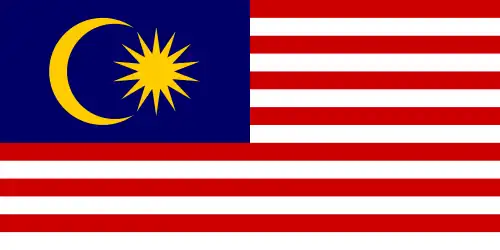


 Flag of Malaysia (Jalur Gemilang)
.svg.png)
 Flag of Malaysia (Banner display)
 Civil Ensign of Malaysia
 Government Ensign of Malaysia


.svg.png)
.svg.png)
.svg.png)


.svg.png)
.svg.png)
.svg.png)


.svg.png)
.svg.png)


.svg.png)




 Kuala Terengganu (district)
 Gua Musang (district)
 Johor Bahru (district)
 Johor Bahru (city)
 Kota Kinabalu (city)
 Sungei Ujong (luak/chiefdom)
 Sabak Bernam (district council)
 Ipoh (city council)
.svg.png)


.svg.png)
.svg.png)


.svg.png)
_(vertical).svg.png)
.svg.png)


.svg.png)
.svg.png)
.svg.png)
.svg.png)


.svg.png)
.svg.png)
.svg.png)
.svg.png)
.svg.png)
.svg.png)
.svg.png)
.svg.png)
.svg.png)
.svg.png)
.svg.png)

.svg.png)
.svg.png)
.svg.png)


.svg.png)
.svg.png)


.svg.png)
.svg.png)


.svg.png)
.svg.png)
.svg.png)
.svg.png)
.svg.png)

.svg.png)
.svg.png)
.svg.png)
.svg.png)
.svg.png)
.svg.png)


