Artiopoda
| Artiopoda Temporal range:
| |
|---|---|

| |
| Misszhouia, a nektaspid | |

| |
| Cheloniellon, a cheloniellid | |
Scientific classification 
| |
| Kingdom: | Animalia |
| Phylum: | Arthropoda |
| (unranked): | Deuteropoda |
| Clade: | †Artiopoda Hou and Bergstrom, 1997 |
| Subgroups | |
| |
Artiopoda is a clade of extinct arthropods that includes trilobites and their close relatives. It was erected by Hou and Bergström in 1997[4] to encompass a wide diversity of arthropods that would traditionally have been assigned to the Trilobitomorpha. Trilobites, in part due to abundance of findings owing to their mineralized exoskeletons, are by far the best recorded, diverse, and long lived members of the clade. Other members, which lack mineralised exoskeletons, are known mostly from Cambrian deposits.[5]
Description

According to Stein and Selden (2012) artiopods are recognised by the possession of filiform (elongate and relatively thin) antennae, limbs with bilobate exopods (upper branches), with the proximal (closest to base of the limb) lobe being elongate and bearing a lamella, while the distal (further from the limb base) lobe is paddle-shaped and setiforous (bearing hair-or bristle like structures). The limb endopod (inner, leg-like branch) has seven podomeres/segments, with first four podomeres bearing inward facing (endite) structures, while podomeres five and six are stenopodous (cylindrical and stout). Common plesiomorphies (ancestral traits) also include the antennules and at least three sets of post-antennular limbs being attached to the head shield, the postantennular limbs having no or little differentiation into distinct morphologies, and broad paratergal folds which contribute to the dorsoventrally (along the up-down axis) flattened look of artiopods.[6] The limbs of artiopods have also been suggested to bear exites, which were described as similar those of the megacheiran Leanchoilia and probably not homologous to those present in crustaceans.[7]
-
_(17966037580)_(cropped).jpg) Restoration of the trilobite Triarthrus eatoni
Restoration of the trilobite Triarthrus eatoni -
 Restoration of Naraoia magna (Nektaspida)
 -
 Life restoration of Sidneyia (Vicissicaudata)
 -
 Diagram of Sinoburius (Xandarellida)
 -
 Diagram of Olenoides serratus (Trilobita)
 -
 Life restoration of Aglaspis (Aglaspidida)
 -
 Life restoration of Tegopelte (Conciliterga)
 -
 Life restoration of Pleuroctenium (Agnostida)
Taxonomy
Internal taxonomy
The Artiopoda have been considered by many studies to consist of two major clades; one reusing Trilobitomorpha to encompass trilobites, nektaspids, concilitergans and xandarellids, and the other called Vicissicaudata encompassing aglaspidids, xenopods and cheloniellids.[8] A small group, Protosutura, comprising Zhiwenia, Acanthomeridion and Australimicola, has been recognised based on the shared presence of simple sutures on the top (dorsal surface) of the carapace where it splits during ecdysis (moulting), and a short tailspine. This group is often placed basal to the Trilobitomorpha-Vicissicaudata split,[9] alongside other taxa like Squamacula. These relationships are not always recovered.[10]
Relationships with other arthropods
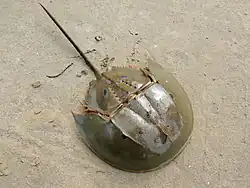
The relationship of Artiopoda with the two major clades of modern arthropods, Chelicerata (the group of sea spiders, horseshoe crabs and arachnids such as spiders and scorpions) and Mandibulata (which contains insects, crustaceans, centipedes and millipedes, among others), are unresolved, with some phylogenies recovering Artiopoda as more closely to chelicerates, forming the clade Arachnomorpha, while others recover Artiopoda as more closely related to mandibulates, forming the clade Antennulata.[11] Some studies place them as stem-group euarthropods, with mandibulates and chelicerates more closely related to each other than either is to Artiopoda.[10] Some studies have recovered a close relationship with Marrellomorpha, with the proposed clade including Artiopoda and Marrellomorpha dubbed Lamellipedia, though this relationship is not found in other analyses.[12][13] The enigmatic artiopodan-like arthropod Kiisortoqia, which bears large "frontal appendages" has been suggested to be closely related to Artiopoda in some analyses.[10]
Phylogeny
Internal phylogeny
After Jiao et al. 2021.[14]
| Artiopoda |
| |||||||||||||||||||||||||||||||||||||||||||||||||||||||||||||||||||||||||||||||||||||||||||||||||||||||||||||||||||||||||||||||||||||||||||||||||||||||||||||||||||||||||||||||||||||||||||||||||||||||||||||||||||||||||||||||||||||||||||||||||||||||||||||||||||||||||||||||||||||||
Implied weights parsimony phylogeny after Berks et al. 2023.[15]
| Artiopoda |
| |||||||||||||||||||||||||||||||||||||||||||||||||||||||||||||||||||||||||||||||||||||||||||||||||||||||||


External phylogeny
Cladogram supporting the Antennulata hypothesis after Liu et al; 2026:[16]
| Panarthropoda |
| |||||||||||||||||||||||||||||||||||||||||||||||||||||||||||||||||||||||||||||||||||||||||||||||||||||||||
.jpg)


.png)


.png)


.jpg)
References
- ^ Liu, Cong; Fu, Dongjing; Wu, Yu; Zhang, Xingliang (July 2024). "Cambrian euarthropod Urokodia aequalis sheds light on the origin of Artiopoda body plan" (PDF). iScience. 27 (8) 110443. Bibcode:2024iSci...27k0443L. doi:10.1016/j.isci.2024.110443. PMC 11325232. PMID 39148713.
- ^ Lerosey-Aubril, Rudy (March 2015). "Notchia weugi gen. et sp. nov.: a new short-headed arthropod from the Weeks Formation Konservat-Lagerstätte (Cambrian; Utah)". Geological Magazine. 152 (2): 351–357. Bibcode:2015GeoM..152..351L. doi:10.1017/S0016756814000375.
- ^ Zhu, Y.; Zeng, H.; Liu, Y.; Zhao, F. (2023). "New artiopodan euarthropods from the Chengjiang fauna (Cambrian, Stage 3) at Malong, Yunnan, China". Acta Palaeontologica Polonica. 68. doi:10.4202/app.01080.2023.
- ^ Hou, X. & Bergström, J. 1997. Arthropods of the Lower Cambrian Chengjiang fauna, southwest China. Fossils and Strata, No. 45. Scandinavian University Press, Oslo, 22 Dec 1997: 116 pp.[1]
- ^ Schmidt, Michel; Hou, Xianguang; Zhai, Dayou; Mai, Huijuan; Belojević, Jelena; Chen, Xiaohan; Melzer, Roland R.; Ortega-Hernández, Javier; Liu, Yu (2022). "Before trilobite legs: Pygmaclypeatus daziensis reconsidered and the ancestral appendicular organization of Cambrian artiopods". Philosophical Transactions of the Royal Society B: Biological Sciences. 377 (1847) 20210030. bioRxiv 10.1101/2021.08.18.456779. doi:10.1098/rstb.2021.0030. PMID 35125003.
- ^ Stein, Martin; Selden, Paul A. (June 2012). "A restudy of the Burgess Shale (Cambrian) arthropod Emeraldella brocki and reassessment of its affinities". Journal of Systematic Palaeontology. 10 (2): 361–383. Bibcode:2012JSPal..10..361S. doi:10.1080/14772019.2011.566634. ISSN 1477-2019. S2CID 55018927.
- ^ Liu, Yu; Edgecombe, Gregory D.; Schmidt, Michel; Bond, Andrew D.; Melzer, Roland R.; Zhai, Dayou; Mai, Huijuan; Zhang, Maoyin; Hou, Xianguang (2021-07-30). "Exites in Cambrian arthropods and homology of arthropod limb branches". Nature Communications. 12 (1): 4619. Bibcode:2021NatCo..12.4619L. doi:10.1038/s41467-021-24918-8. ISSN 2041-1723. PMC 8324779. PMID 34330912.
- ^ Ortega-Hernández, Javier; Legg, David A.; Braddy, Simon J. (February 2013). "The phylogeny of aglaspidid arthropods and the internal relationships within Artiopoda". Cladistics. 29 (1): 15–45. Bibcode:2013Cladi..29...15O. doi:10.1111/j.1096-0031.2012.00413.x. PMID 34814371. S2CID 85744103.
- ^ Du, Kun-sheng; Ortega-Hernández, Javier; Yang, Jie; Zhang, Xi-guang (June 2019). "A soft-bodied euarthropod from the early Cambrian Xiaoshiba Lagerstätte of China supports a new clade of basal artiopodans with dorsal ecdysial sutures". Cladistics. 35 (3): 269–281. doi:10.1111/cla.12344. PMID 34622993.
- ^ a b c Berks, H. O.; Lunde Nielsen, M.; Flannery-Sutherland, J.; Thorshøj Nielsen, A.; Park, T.-Y. S.; Vinther, J. (2023). "A possibly deep branching artiopodan arthropod from the lower Cambrian Sirius Passet Lagerstätte (North Greenland)". Papers in Palaeontology. 9 (3) e1495. Bibcode:2023PPal....9E1495B. doi:10.1002/spp2.1495.
- ^ Aria, Cédric (2022-04-26). "The origin and early evolution of arthropods". Biological Reviews. 97 (5): 1786–1809. Bibcode:2022BioRv..97.1786A. doi:10.1111/brv.12864. ISSN 1464-7931. PMID 35475316. S2CID 243269510.
- ^ Moysiuk, Joseph; Izquierdo-López, Alejandro; Kampouris, George E.; Caron, Jean-Bernard (July 2022). "A new marrellomorph arthropod from southern Ontario: a rare case of soft-tissue preservation on a Late Ordovician open marine shelf". Journal of Paleontology. 96 (4): 859–874. Bibcode:2022JPal...96..859M. doi:10.1017/jpa.2022.11. ISSN 0022-3360.
- ^ Stein, Martin (November 2013). "Cephalic and appendage morphology of the Cambrian arthropod Sidneyia inexpectans". Zoologischer Anzeiger - A Journal of Comparative Zoology. 253 (2): 164–178. doi:10.1016/j.jcz.2013.05.001.
- ^ Jiao, De-Guang; Du, Kun-Sheng; Zhang, Xi-Guang; Yang, Jie; Eggink, Daniel (May 2022). "A new small soft-bodied non-trilobite artiopod from the Cambrian Stage 4 Guanshan Biota". Geological Magazine. 159 (5): 730–734. Bibcode:2022GeoM..159..730J. doi:10.1017/S0016756821001254. ISSN 0016-7568.
- ^ Berks, H. O.; Nielsen, M. L.; Flannery-Sutherland, J.; Nielsen, A. T.; Park, T.-Y. S.; Vinther, J. (2023). "A possibly deep branching artiopodan arthropod from the lower Cambrian Sirius Passet Lagerstätte (North Greenland)". Papers in Palaeontology. 9 (3). e1495. Bibcode:2023PPal....9E1495B. doi:10.1002/spp2.1495. S2CID 259253098.
- ^ Liu, Cong; Pates, Stephen; Zhang, Mingjing; Wu, Yu; Ma, Jiaxin; Fu, Dongjing; Zhang, Xingliang (2026-03-21). "3D morphology of the Cambrian bivalved arthropod Sunella informs about head segmentation, arthrodization, and arthropodization". Communications Biology. doi:10.1038/s42003-026-09909-z. ISSN 2399-3642.
| ||||||||||||||||||||||||||||||||||||||||||
|
 | |||||||||||||||||||||||||||||||||||||||||
|


